Recycle the ISS
Recycle the ISS
The Issue
Summary (just read this if you're in a hurry)
The United States and participating nations have agreed to decommission the International Space Station (ISS) by the year 2030. Continued operation beyond that is cost prohibitive. Simply vacating it is not an option, as uncontrolled reentry could present real economic, environmental, and moral hazards. The default plan of a controlled deorbit will cost the US government a billion dollars, upon which the ISS will burn up in the atmosphere with any remains crashing into the ocean. Meanwhile, the growing space economy will require an equivalent amount of materials to be relaunched. Instead, we ask Congress and NASA to incentivize the closure of critical technology gaps in orbital processing by recycling the ISS into orbital feedstock materials as an alternative approach to deorbiting it. The value of materials in the ISS, which would otherwise be forever removed from Humanity’s use, could be used as the primary incentive for commercial interests to advance orbital processing capabilities and kickstart a circular economy, building new satellites and space stations. The taxpayer investment would be a small fraction of deorbiting costs, and set a positive example of leadership in space.
Keep reading if you want details, or scroll to the FAQ, or sign now!
Background
The International Space Station (ISS) has been a pivotal platform for space development and exploration since its first module was launched in 1998. Since then, it has been the premier facility for international cooperation and the establishment of a permanent human presence in space. It's also served for microgravity research and technological advancement, especially in the realm of In-space Servicing, Assembly, and Manufacturing (ISAM), which promises to be a high growth industry in its own right within the next decade [IN-SPACE SERVICING, ASSEMBLY, AND MANUFACTURING INTERAGENCY WORKING GROUP].
Simultaneously in this time, the commercial satellite industry has ramped to exponential growth- both in economic terms and in mass accumulation in Earth orbit. This industry has provided a critical pillar of orbital infrastructure upon which a thriving orbital economy can be built. Most of this satellite industry growth can be attributed to a foundation of reusability driven cost reductions in the launch industry, demonstrating that sustainability has economic benefits on top of the clear environmental ones. However, one of the major consequences of this growth is that orbital congestion is becoming a very real concern, with potential to cause severe safety issues for human spaceflight, and adversely impact future industry growth by significantly increasing the overall cost of satellite deployment and operation.
Such concerns have led to much recent discussion of remediation solutions [Colvin et al.] and ways to incentivize cleanup of orbital debris [Hickenlooper]. Orbital debris consists of defunct satellites, spent rocket stages, and other fragments resulting from previous space missions. It poses significant risks to operational spacecraft and astronauts, as even small debris pieces can cause catastrophic collisions due to their high relative velocities. The direction of “doing nothing” about orbital debris is not a responsible solution, as the continued accumulation of orbital debris significantly increases risks of orbital collisions, which can cascade into more collisions, putting both human spaceflight and satellite operations at risk. To mitigate the orbital debris problem, two categories of technology and two types of incentives can be applied to form four quadrants of potential policy direction shown in the attached image.
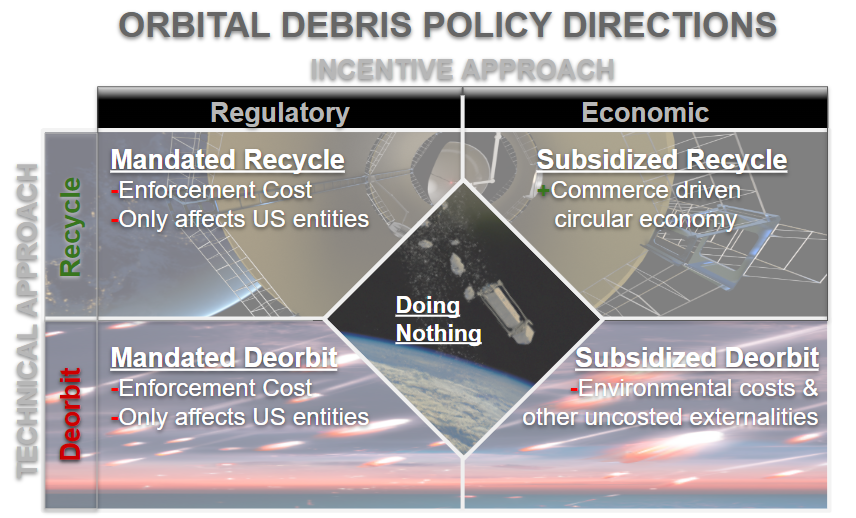
So far, there is no matured technology solution for recycling on orbit, so deorbiting is currently the only option. Strategic policy, however, should be governed by the desired state rather than the limitations of the status quo. Deorbiting technology exists because seven decades of government sponsored missions have successfully created and advanced it. Deorbiting entails the vaporization of debris into the Earth’s upper atmosphere with any surviving materials targeted for the ocean depths (if deorbit is responsibly controlled), where they will never again be accessible to human civilization. Measured by mission cost of an individual satellite, deorbit may seem simpler and cheaper than capturing, transporting, and recycling a defunct satellite. However, when the replacement cost of the satellite infrastructure is included, it is far less expensive to the nascent orbital economy and Earth’s environment to reutilize satellite materials without having to re-mine, re-refine, and re-launch them from Earth. Manufacturing satellites and components in orbit also eliminates the need for overengineering to survive launch conditions, further reducing total satellite deployment cost. Recycling technology is not only feasible, it is energetically favored, and must catch up technologically to compete economically.
There are capability gaps across the board in creating such a circular space economy. Currently, there are several logistics ventures pursuing the development of capture, service, and transport capabilities. There are also a variety of companies developing capabilities to leverage microgravity and abundant vacuum for manufacturing advanced materials and biopharmaceuticals to be returned back to Earth (limited to high value:mass ratio). Both of these sectors are still at low technology readiness levels (TRL-5 or lower), with business readiness hampered by the high cost of getting feedstock material in orbit. Accessing the materials already in orbit through recycling orbital debris would open the economy to products manufactured in space for space application. This space to space economy (#S2S) is represented by the commercial satellite sector with a 2023 total addressable market of $20B, growing exponentially. However, recycling lags in technology maturity even compared to its sister sectors of transport and manufacturing. The three sectors must converge in readiness to synergize collective commercial viability, ideally with conjunction sooner rather than later.
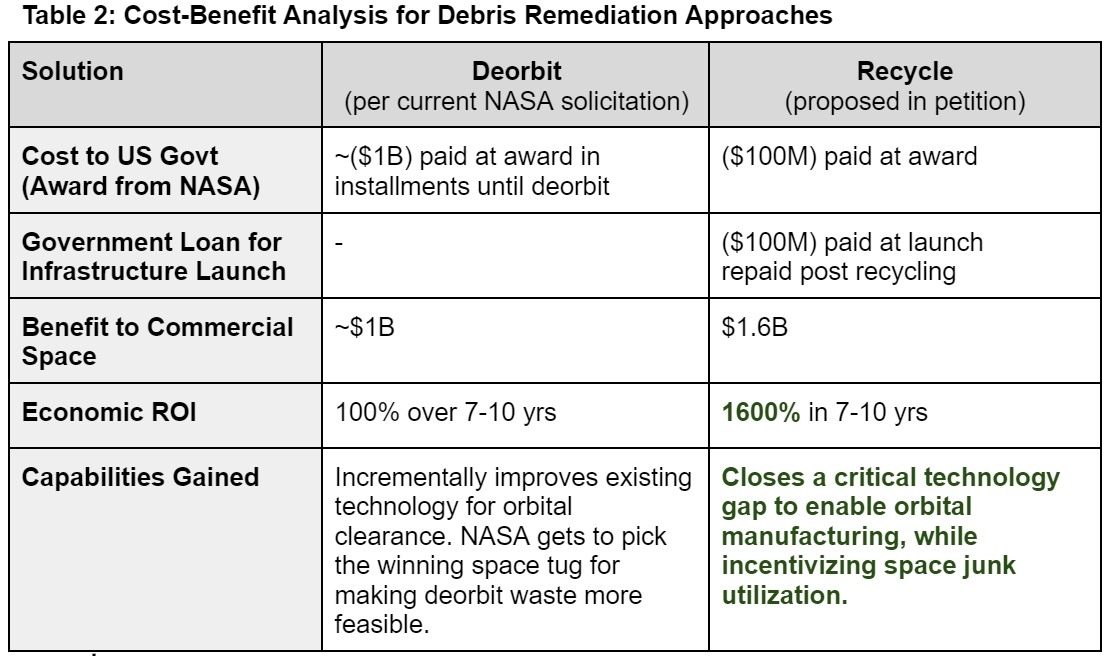
The largest deposit of materials in low Earth orbit is the ISS, comprising approximately 430 metric tons of space grade materials. At current minimum launch cost of $3,500 per kilogram (based on Falcon 9 pricing, which just increased in 2023), the value of material comprising the ISS can be estimated at $1.5B. The ISS is scheduled for decommissioning in 2030, and NASA is currently [pre]soliciting for industry responses to deorbit the station at a funding level of ~$1B [NASA JOHNSON SPACE CENTER]. This approach can be seen as a direct reaction to Russia’s announced withdrawal from the ISS in 2028. Prior to this, the ISS deorbit plan involved using three Russian Progress vehicles, but with cost sharing specifics never really determined [NASA].
Proposed Solution
We call for Congress to fund NASA for closing the critical technology gaps in recycling orbital debris. Nominally this could be incorporated into the ORBITS Act now being worked on in the US Senate. We call for NASA to sponsor a request for proposals (RFP) from industry for recycling the ISS on orbit. We call for other member nations of the ISS to collaborate and support this effort through technology development, and developing a legal framework for international commerce in space, across the sectors of insurance, finance, and law.
We propose that for NASA’s Recycling RFP, approximately $100M is awarded to develop technologies for closing the gaps in orbital recycling. The key selection criteria for the award should be the a) feasibility of successful deployment by 2030, and b) % of station materials used. We propose that the launch cost of proposed hardware facility deployment also be included as a government loan with value of the materials transferred as collateral (using the per kg launch cost contracted). Ownership (assets and liability) of ISS will transfer to those companies at decommissioning. At current launch rates ($3,500/kg minimum), the 430 tons of material comprising the ISS are worth at least $1.5B, providing a better incentive to commercial ventures, costing NASA only 10% of the deorbit plan, while producing new processing capabilities and infrastructure in space, and setting an international leadership example for sustainability and environmental stewardship. as shown in Table 2, this direction will result in less money from taxpayers, more payoff for commercial development and investors, and more benefit to humanity.
Call to Action
This petition is intended to bring visibility to the topic of orbital debris in a way that will create a sustainable flow of material resources to bootstrap a growing circular economy in space. Please sign the petition on Change.org and if you are a US citizen, contact your senators and congressional representatives, urging them to provide the foresight and leadership to make the US a responsible leader in developing space for humanity. Initial focus needs to be on senators comprising the US Senate Committee on Commerce, Science, and Transportation (listed at https://www.commerce.senate.gov/members Time is of the essence in taking this action, as the ORBITS Act is going through the Senate now (as of May 2023), and to close the many recycling technology gaps before ISS is decommissioned in 2030, we must start NOW! If you are a citizen of a member nation participating in the ISS, please contact your government leaders to make them aware of the possibilities for international collaboration in making the global space economy sustainable and equitable.
FAQ
Q1. Can’t the ISS continue by being maintained as a cultural heritage site?
Operating the ISS carries a significant annual cost: $1.3B, which is expected to increase with age [NASA]. This is the driving factor in the desire to decommission it. The reassignment of those funds toward other space development efforts such as Artemis is preferred within NASA, across the congressional aisle, and in the international commercial space industry. Several commercial interests have already come forward to take up the mantle for continuing microgravity research, orbital manufacturing, and space tourism with new station architectures. If a commercial interest likewise found a way to close the business case for purchasing and preserving one or more ISS modules for museum/tourism purposes, the proposed recycling plan could also enable that, while permitting the participating international government agencies to transfer their commitments to new endeavors.
Q2. Isn’t it better to reuse the ISS than to recycle it?
There will certainly be components of the ISS that can be reused. However, space is a harsh environment so most components have undergone significant wear and tear due to vacuum sublimation, UV radiation, and micrometeor ablation. Vacuum welding will make it difficult to disassemble many components without damaging them beyond simple reuse. And technology has improved in many areas since the ISS was designed, so better capability using less material can be achieved by leveraging state-of-art designs. Also, many systems have extra structural design margins (i.e. more material) to ensure survival of the launch from Earth. Manufacturing new space products in space will not require this added design margin. It is therefore more efficient in most cases to break recyclable materials down to the feedstock level (for use in orbital manufacturing) rather than reusing or refurbishing components. This approach also leverages market efficiencies in directing materials to where they are most valuable at the time. Recycling materials into orbital feedstocks will also synergistically grow the orbital manufacturing sector, and can provide both propellant and customers for the capture, service and transport sector.
Q3. Won’t the structural integrity and aging of the ISS be a challenge for recycling it?
The ISS has been in orbit for over two decades, and its structural integrity and components have undergone significant wear and tear. Ensuring the stability and safety of the station during the recycling process must certainly be a required task. However, the ISS need not be inhabited for it to be recycled. Stationkeeping will continue to be an operational cost for the depot processing the ISS components (as it will also for the Axiom module currently planned to remain post ISS decommissioning). The recycling ventures should certainly account for this in their proposed solutions.
Q4. The ISS has been a bastion of international diplomacy for the last quarter century. What will replace that critical function?
This is an excellent question with equal relevance to all decommissioning solutions (including both recycling and deorbit). We propose the solicitation for recycling solutions should be open to commercial entities from all nations participating in ISS at the time of decommissioning. Creating a vibrant circular space economy will require cross company collaboration on many levels, as well as the establishment of an international commerce framework going beyond the Outer Space Treaty [Beckenstein]. The recycling effort can serve to identify the gaps in international space law and accelerate their solutions at the same time the technical gaps are being resolved.
Q5. Who pays for the proposed recycling effort?
It is useful to view the costs of developing this capability as an investment. We propose that, in lieu of NASA spending $1B on the current deorbit plan [NASA JOHNSON SPACE CENTER], approximately $100M is split between up to five companies to develop technologies for closing the critical gaps in orbital recycling. Ownership (assets and liability) of ISS will transfer to those companies at decommissioning. At current launch rates ($3,500/kg minimum), the 430 tons of material comprising the ISS are worth at least $1.5B, providing a better incentive to commercial ventures, costing NASA only 10% of the deorbit plan. In return, it produces new processing capabilities in space, and sets an international leadership example for sustainability and environmental stewardship. This direction will result in less money from taxpayers, more payoff for commercial development and investors, and more benefit to humanity. Regardless of measure, it’s a higher return on investment (ROI).
Q6. Hasn’t NASA already done a trade study on recycling vs. deorbiting?
NASA recently published a Cost and Benefits Analysis on Orbital Debris Remediation (Colvin et al.). While its analysis did not incorporate the replacement cost in satellite deployment, it did conclude that for cost parity of the recycling solution, technology remains a large gap. NASA also sponsored the Orbital Alchemy Challenge in 2022, with total prize funding at $55k- less than 1/10,000th of the funding proposed for the apparent deorbit direction (~$1B). If NASA wants to compare solutions (deorbit vs. recycle) without bias, both solutions need to be equitably funded. However, it can be argued that NASA’s role should be to find and strategically close technology gaps rather than ignoring uncosted externalities to rationalize the nearest term cheaper solution.
Q7. Isn’t it cheaper/better to source material resources from the Moon or asteroids?
The same technology gaps (and more) exist for mining lunar regolith and asteroids as for recycling. And unlike LEO, there is currently no infrastructure in deep space or on the Moon to provide commercial demand for those materials. If we can’t process already refined space grade materials consolidated in tracked orbits close to Earth, constructed to stay together, with bills of materials and design information already documented, how will we possibly prospect, capture, transport, and mine ore from piles of rubble and electrostatic dust much farther from Earth? Closing the technology gap for recycling on orbit also closes the gap for other ISRU efforts, potentially including the very important one of creating a circular economy on Earth.
Q8. Isn't it a little late for NASA to change directions?
Developing technological capabilities for orbital recycling within the next six years will certainly be a challenge, but much less so if adequately supported. As the saying goes: the best time to plant a tree is 20 years ago. The second best time is now. Humanity cannot afford to miss this opportunity.
Q9. Why should the award be $100M? Why not more? Why not less?
Recycling space materials in orbit ultimately needs to be a commercial endeavor. In order to incentivize this it is ideal to use the $1.5B material value as the main prize. By itself, this is nearly sufficient to motivate investors to fund orbital recycling endeavors, but there are still risks in policy, international law, and technology development. $100M will allay the tech development risks and send a market signal to investors that the US Govt supports the approach, as well as vest the US in reducing policy and legal risks. It will most certainly require funding beyond $100M to advance the state of technology before 2030, but it is reasonable to expect commercial interests to pick up that additional commitment. It is unlikely that a higher award would substantially accelerate development, but it would likely take longer to be approved by Congress. It is likely that the $100M award will be split between multiple companies/subcontracts comprising a consortium for the proposals. The goal of this petition is to maximize the likelihood of successfully creating a sustainable and thriving circular economy in orbit, and on Earth. Reducing the waste of taxpayer funds being dumped into the ocean is a good start.
Q10. We can't even recycle our trash on Earth. Why would it make economic sense to do it in space?
Terrestrial recycling indeed has challenges of its own, mostly economic but partially technological. In the North America, around 3 million tons of aluminum and 80 million tons of steel are recycled every year, but equivalent amounts end up in landfills. The competing mining and refining industries have built up infrastructure, including the surface transportation element that enables cost effective resource extraction on the opposite side of the planet.The recycling industry is still determining how to fashion a terrestrial circular economy that can compete economically with this existing infrastructure whose technological head start dates to before the industrial revolution. Orbital recycling does not have to contend with this because the cost of launching any material from Earth’s surface remains substantial and there are no existing mining or refining industries in orbit. However, the steps of capturing, transporting, and processing space debris into manufacturing feedstocks on orbit still present a number of general challenges, both technical and economic. As with many technologies created in space, it's entirely likely they can be used to make progress for terrestrial life too.
Q11. With the Moon and asteroids, isn't space full of resources? Why recycle satellites if space resources are abundant?
There are two problems with tapping into natural space resources.
The first is that we don't (yet) have the technology. Catching an asteroid made of a loose pile of gravel and electrostatic dust is much harder than catching a satellite. Same for transporting them. It's much harder to find asteroids in deep space and then get to deep space than it is to find an old satellite in Earth orbit (right where we left it) and get there (again). And it's harder to prospect an asteroid for valuables than it is to read a bill of materials and a blueprint (both on file for most satellites) to know ahead of time whether it's worth mining. And it's easier (less energy intensive and less waste material) to reprocess the space grade alloys and materials in a satellite than it is to refine various ores from lunar or asteroid regolith.
The second problem is that space is big. Really big. You just won't believe how vastly hugely mind-bogglingly big it is.That means everything is a long ways apart. Moving in space requires (generally) throwing propellant out of a rocket nozzle, so the cost of orbit changes is propellant, which right now all comes from Earth, and costs at least as much as anything else to get into orbit ($3,500/kg minimum). The more massive something is and the more different the orbit, and the faster you want to get there, the more propellant it takes. Low Earth orbit is where the market growth is happening. It's also where the highest grade materials are. Makes sense to use them where they are, and are needed in LEO. Recycling the ISS is the gateway to tapping into all space resources.
Q12. Does this actually fall into NASA's mission?
Yes! Title 51 restates the National Aeronautics and Space Act of 1958:
§20102. Congressional declaration of policy and purpose...(c) Commercial Use of Space.—Congress declares that the general welfare of the United States requires that the Administration seek and encourage, to the maximum extent possible, the fullest commercial use of space.(d) Objectives of Aeronautical and Space Activities.—The aeronautical and space activities of the United States shall be conducted so as to contribute materially to one or more of the following objectives:...(5) The preservation of the role of the United States as a leader in aeronautical and space science and technology and in the application thereof to the conduct of peaceful activities within and outside the atmosphere.... (9) The preservation of the United States preeminent position in aeronautics and space through research and technology development related to associated manufacturing processes.
Works Cited
Beckenstein, Zoe. “Governing The Galaxies: Analyzing Tort Applicability in Space.” Columbia Undergraduate Law Review, vol. Online, 2023. Columbia Undergraduate Law Review, https://www.culawreview.org/journal/governing-the-galaxies-analyzing-tort-applicability-in-space. Accessed 24 MAY 2023.
Colvin, Thomas J., et al. Cost and Benefit Analysis of Orbital Debris Remediation. 2023. NASA Office of Technology, Policy, and Strategy (OTPS), https://www.nasa.gov/sites/default/files/atoms/files/otps_-_cost_and_benefit_analysis_of_orbital_debris_remediation_-_final.pdf.
The Hague Institute for Global Justice. “The Washington Compact on Norms of Behavior for Commercial Space Operations.” ASSOCIATION OF SPACE EXPLORERS, 2023, https://space-explorers.org/resources/Documents/The%20Washington%20Compact%20-%20ASE.pdf. Accessed 24 MAY 2023.
Hickenlooper, John W. “Text - S.447 - 118th Congress (2023-2024): ORBITS Act of 2023.” Congress.gov, https://www.congress.gov/bill/118th-congress/senate-bill/447/text. Accessed 24 May 2023.
IN-SPACE SERVICING, ASSEMBLY, AND MANUFACTURING INTERAGENCY WORKING GROUP, editor. National In-Space Servicing, Assembly, and Manufacturing Implementation Plan. December 2022, https://www.whitehouse.gov/wp-content/uploads/2022/12/NATIONAL-ISAM-IMPLEMENTATION-PLAN.pdf.
NASA. International Space Station Transition Report. pursuant to Section 303(c)(2) of the NASA Transition Authorization Act of 2017 (P.L. 115-10). 2022. International Space Station Transition Report, https://www.nasa.gov/sites/default/files/atoms/files/2022_iss_transition_report-final_tagged.pdf. Accessed 21 MAY 2023.
NASA JOHNSON SPACE CENTER. “Notice ID: 80JSC022ISSDeorbit International Space Station Deorbit Capability.” SAM.gov, 2023, https://sam.gov/opp/e193e855756b4ec2bc8ede228b5eee78/view. Accessed 21 MAY 2023.

295
The Issue
Summary (just read this if you're in a hurry)
The United States and participating nations have agreed to decommission the International Space Station (ISS) by the year 2030. Continued operation beyond that is cost prohibitive. Simply vacating it is not an option, as uncontrolled reentry could present real economic, environmental, and moral hazards. The default plan of a controlled deorbit will cost the US government a billion dollars, upon which the ISS will burn up in the atmosphere with any remains crashing into the ocean. Meanwhile, the growing space economy will require an equivalent amount of materials to be relaunched. Instead, we ask Congress and NASA to incentivize the closure of critical technology gaps in orbital processing by recycling the ISS into orbital feedstock materials as an alternative approach to deorbiting it. The value of materials in the ISS, which would otherwise be forever removed from Humanity’s use, could be used as the primary incentive for commercial interests to advance orbital processing capabilities and kickstart a circular economy, building new satellites and space stations. The taxpayer investment would be a small fraction of deorbiting costs, and set a positive example of leadership in space.
Keep reading if you want details, or scroll to the FAQ, or sign now!
Background
The International Space Station (ISS) has been a pivotal platform for space development and exploration since its first module was launched in 1998. Since then, it has been the premier facility for international cooperation and the establishment of a permanent human presence in space. It's also served for microgravity research and technological advancement, especially in the realm of In-space Servicing, Assembly, and Manufacturing (ISAM), which promises to be a high growth industry in its own right within the next decade [IN-SPACE SERVICING, ASSEMBLY, AND MANUFACTURING INTERAGENCY WORKING GROUP].
Simultaneously in this time, the commercial satellite industry has ramped to exponential growth- both in economic terms and in mass accumulation in Earth orbit. This industry has provided a critical pillar of orbital infrastructure upon which a thriving orbital economy can be built. Most of this satellite industry growth can be attributed to a foundation of reusability driven cost reductions in the launch industry, demonstrating that sustainability has economic benefits on top of the clear environmental ones. However, one of the major consequences of this growth is that orbital congestion is becoming a very real concern, with potential to cause severe safety issues for human spaceflight, and adversely impact future industry growth by significantly increasing the overall cost of satellite deployment and operation.
Such concerns have led to much recent discussion of remediation solutions [Colvin et al.] and ways to incentivize cleanup of orbital debris [Hickenlooper]. Orbital debris consists of defunct satellites, spent rocket stages, and other fragments resulting from previous space missions. It poses significant risks to operational spacecraft and astronauts, as even small debris pieces can cause catastrophic collisions due to their high relative velocities. The direction of “doing nothing” about orbital debris is not a responsible solution, as the continued accumulation of orbital debris significantly increases risks of orbital collisions, which can cascade into more collisions, putting both human spaceflight and satellite operations at risk. To mitigate the orbital debris problem, two categories of technology and two types of incentives can be applied to form four quadrants of potential policy direction shown in the attached image.
So far, there is no matured technology solution for recycling on orbit, so deorbiting is currently the only option. Strategic policy, however, should be governed by the desired state rather than the limitations of the status quo. Deorbiting technology exists because seven decades of government sponsored missions have successfully created and advanced it. Deorbiting entails the vaporization of debris into the Earth’s upper atmosphere with any surviving materials targeted for the ocean depths (if deorbit is responsibly controlled), where they will never again be accessible to human civilization. Measured by mission cost of an individual satellite, deorbit may seem simpler and cheaper than capturing, transporting, and recycling a defunct satellite. However, when the replacement cost of the satellite infrastructure is included, it is far less expensive to the nascent orbital economy and Earth’s environment to reutilize satellite materials without having to re-mine, re-refine, and re-launch them from Earth. Manufacturing satellites and components in orbit also eliminates the need for overengineering to survive launch conditions, further reducing total satellite deployment cost. Recycling technology is not only feasible, it is energetically favored, and must catch up technologically to compete economically.
There are capability gaps across the board in creating such a circular space economy. Currently, there are several logistics ventures pursuing the development of capture, service, and transport capabilities. There are also a variety of companies developing capabilities to leverage microgravity and abundant vacuum for manufacturing advanced materials and biopharmaceuticals to be returned back to Earth (limited to high value:mass ratio). Both of these sectors are still at low technology readiness levels (TRL-5 or lower), with business readiness hampered by the high cost of getting feedstock material in orbit. Accessing the materials already in orbit through recycling orbital debris would open the economy to products manufactured in space for space application. This space to space economy (#S2S) is represented by the commercial satellite sector with a 2023 total addressable market of $20B, growing exponentially. However, recycling lags in technology maturity even compared to its sister sectors of transport and manufacturing. The three sectors must converge in readiness to synergize collective commercial viability, ideally with conjunction sooner rather than later.
The largest deposit of materials in low Earth orbit is the ISS, comprising approximately 430 metric tons of space grade materials. At current minimum launch cost of $3,500 per kilogram (based on Falcon 9 pricing, which just increased in 2023), the value of material comprising the ISS can be estimated at $1.5B. The ISS is scheduled for decommissioning in 2030, and NASA is currently [pre]soliciting for industry responses to deorbit the station at a funding level of ~$1B [NASA JOHNSON SPACE CENTER]. This approach can be seen as a direct reaction to Russia’s announced withdrawal from the ISS in 2028. Prior to this, the ISS deorbit plan involved using three Russian Progress vehicles, but with cost sharing specifics never really determined [NASA].
Proposed Solution
We call for Congress to fund NASA for closing the critical technology gaps in recycling orbital debris. Nominally this could be incorporated into the ORBITS Act now being worked on in the US Senate. We call for NASA to sponsor a request for proposals (RFP) from industry for recycling the ISS on orbit. We call for other member nations of the ISS to collaborate and support this effort through technology development, and developing a legal framework for international commerce in space, across the sectors of insurance, finance, and law.
We propose that for NASA’s Recycling RFP, approximately $100M is awarded to develop technologies for closing the gaps in orbital recycling. The key selection criteria for the award should be the a) feasibility of successful deployment by 2030, and b) % of station materials used. We propose that the launch cost of proposed hardware facility deployment also be included as a government loan with value of the materials transferred as collateral (using the per kg launch cost contracted). Ownership (assets and liability) of ISS will transfer to those companies at decommissioning. At current launch rates ($3,500/kg minimum), the 430 tons of material comprising the ISS are worth at least $1.5B, providing a better incentive to commercial ventures, costing NASA only 10% of the deorbit plan, while producing new processing capabilities and infrastructure in space, and setting an international leadership example for sustainability and environmental stewardship. as shown in Table 2, this direction will result in less money from taxpayers, more payoff for commercial development and investors, and more benefit to humanity.
Call to Action
This petition is intended to bring visibility to the topic of orbital debris in a way that will create a sustainable flow of material resources to bootstrap a growing circular economy in space. Please sign the petition on Change.org and if you are a US citizen, contact your senators and congressional representatives, urging them to provide the foresight and leadership to make the US a responsible leader in developing space for humanity. Initial focus needs to be on senators comprising the US Senate Committee on Commerce, Science, and Transportation (listed at https://www.commerce.senate.gov/members Time is of the essence in taking this action, as the ORBITS Act is going through the Senate now (as of May 2023), and to close the many recycling technology gaps before ISS is decommissioned in 2030, we must start NOW! If you are a citizen of a member nation participating in the ISS, please contact your government leaders to make them aware of the possibilities for international collaboration in making the global space economy sustainable and equitable.
FAQ
Q1. Can’t the ISS continue by being maintained as a cultural heritage site?
Operating the ISS carries a significant annual cost: $1.3B, which is expected to increase with age [NASA]. This is the driving factor in the desire to decommission it. The reassignment of those funds toward other space development efforts such as Artemis is preferred within NASA, across the congressional aisle, and in the international commercial space industry. Several commercial interests have already come forward to take up the mantle for continuing microgravity research, orbital manufacturing, and space tourism with new station architectures. If a commercial interest likewise found a way to close the business case for purchasing and preserving one or more ISS modules for museum/tourism purposes, the proposed recycling plan could also enable that, while permitting the participating international government agencies to transfer their commitments to new endeavors.
Q2. Isn’t it better to reuse the ISS than to recycle it?
There will certainly be components of the ISS that can be reused. However, space is a harsh environment so most components have undergone significant wear and tear due to vacuum sublimation, UV radiation, and micrometeor ablation. Vacuum welding will make it difficult to disassemble many components without damaging them beyond simple reuse. And technology has improved in many areas since the ISS was designed, so better capability using less material can be achieved by leveraging state-of-art designs. Also, many systems have extra structural design margins (i.e. more material) to ensure survival of the launch from Earth. Manufacturing new space products in space will not require this added design margin. It is therefore more efficient in most cases to break recyclable materials down to the feedstock level (for use in orbital manufacturing) rather than reusing or refurbishing components. This approach also leverages market efficiencies in directing materials to where they are most valuable at the time. Recycling materials into orbital feedstocks will also synergistically grow the orbital manufacturing sector, and can provide both propellant and customers for the capture, service and transport sector.
Q3. Won’t the structural integrity and aging of the ISS be a challenge for recycling it?
The ISS has been in orbit for over two decades, and its structural integrity and components have undergone significant wear and tear. Ensuring the stability and safety of the station during the recycling process must certainly be a required task. However, the ISS need not be inhabited for it to be recycled. Stationkeeping will continue to be an operational cost for the depot processing the ISS components (as it will also for the Axiom module currently planned to remain post ISS decommissioning). The recycling ventures should certainly account for this in their proposed solutions.
Q4. The ISS has been a bastion of international diplomacy for the last quarter century. What will replace that critical function?
This is an excellent question with equal relevance to all decommissioning solutions (including both recycling and deorbit). We propose the solicitation for recycling solutions should be open to commercial entities from all nations participating in ISS at the time of decommissioning. Creating a vibrant circular space economy will require cross company collaboration on many levels, as well as the establishment of an international commerce framework going beyond the Outer Space Treaty [Beckenstein]. The recycling effort can serve to identify the gaps in international space law and accelerate their solutions at the same time the technical gaps are being resolved.
Q5. Who pays for the proposed recycling effort?
It is useful to view the costs of developing this capability as an investment. We propose that, in lieu of NASA spending $1B on the current deorbit plan [NASA JOHNSON SPACE CENTER], approximately $100M is split between up to five companies to develop technologies for closing the critical gaps in orbital recycling. Ownership (assets and liability) of ISS will transfer to those companies at decommissioning. At current launch rates ($3,500/kg minimum), the 430 tons of material comprising the ISS are worth at least $1.5B, providing a better incentive to commercial ventures, costing NASA only 10% of the deorbit plan. In return, it produces new processing capabilities in space, and sets an international leadership example for sustainability and environmental stewardship. This direction will result in less money from taxpayers, more payoff for commercial development and investors, and more benefit to humanity. Regardless of measure, it’s a higher return on investment (ROI).
Q6. Hasn’t NASA already done a trade study on recycling vs. deorbiting?
NASA recently published a Cost and Benefits Analysis on Orbital Debris Remediation (Colvin et al.). While its analysis did not incorporate the replacement cost in satellite deployment, it did conclude that for cost parity of the recycling solution, technology remains a large gap. NASA also sponsored the Orbital Alchemy Challenge in 2022, with total prize funding at $55k- less than 1/10,000th of the funding proposed for the apparent deorbit direction (~$1B). If NASA wants to compare solutions (deorbit vs. recycle) without bias, both solutions need to be equitably funded. However, it can be argued that NASA’s role should be to find and strategically close technology gaps rather than ignoring uncosted externalities to rationalize the nearest term cheaper solution.
Q7. Isn’t it cheaper/better to source material resources from the Moon or asteroids?
The same technology gaps (and more) exist for mining lunar regolith and asteroids as for recycling. And unlike LEO, there is currently no infrastructure in deep space or on the Moon to provide commercial demand for those materials. If we can’t process already refined space grade materials consolidated in tracked orbits close to Earth, constructed to stay together, with bills of materials and design information already documented, how will we possibly prospect, capture, transport, and mine ore from piles of rubble and electrostatic dust much farther from Earth? Closing the technology gap for recycling on orbit also closes the gap for other ISRU efforts, potentially including the very important one of creating a circular economy on Earth.
Q8. Isn't it a little late for NASA to change directions?
Developing technological capabilities for orbital recycling within the next six years will certainly be a challenge, but much less so if adequately supported. As the saying goes: the best time to plant a tree is 20 years ago. The second best time is now. Humanity cannot afford to miss this opportunity.
Q9. Why should the award be $100M? Why not more? Why not less?
Recycling space materials in orbit ultimately needs to be a commercial endeavor. In order to incentivize this it is ideal to use the $1.5B material value as the main prize. By itself, this is nearly sufficient to motivate investors to fund orbital recycling endeavors, but there are still risks in policy, international law, and technology development. $100M will allay the tech development risks and send a market signal to investors that the US Govt supports the approach, as well as vest the US in reducing policy and legal risks. It will most certainly require funding beyond $100M to advance the state of technology before 2030, but it is reasonable to expect commercial interests to pick up that additional commitment. It is unlikely that a higher award would substantially accelerate development, but it would likely take longer to be approved by Congress. It is likely that the $100M award will be split between multiple companies/subcontracts comprising a consortium for the proposals. The goal of this petition is to maximize the likelihood of successfully creating a sustainable and thriving circular economy in orbit, and on Earth. Reducing the waste of taxpayer funds being dumped into the ocean is a good start.
Q10. We can't even recycle our trash on Earth. Why would it make economic sense to do it in space?
Terrestrial recycling indeed has challenges of its own, mostly economic but partially technological. In the North America, around 3 million tons of aluminum and 80 million tons of steel are recycled every year, but equivalent amounts end up in landfills. The competing mining and refining industries have built up infrastructure, including the surface transportation element that enables cost effective resource extraction on the opposite side of the planet.The recycling industry is still determining how to fashion a terrestrial circular economy that can compete economically with this existing infrastructure whose technological head start dates to before the industrial revolution. Orbital recycling does not have to contend with this because the cost of launching any material from Earth’s surface remains substantial and there are no existing mining or refining industries in orbit. However, the steps of capturing, transporting, and processing space debris into manufacturing feedstocks on orbit still present a number of general challenges, both technical and economic. As with many technologies created in space, it's entirely likely they can be used to make progress for terrestrial life too.
Q11. With the Moon and asteroids, isn't space full of resources? Why recycle satellites if space resources are abundant?
There are two problems with tapping into natural space resources.
The first is that we don't (yet) have the technology. Catching an asteroid made of a loose pile of gravel and electrostatic dust is much harder than catching a satellite. Same for transporting them. It's much harder to find asteroids in deep space and then get to deep space than it is to find an old satellite in Earth orbit (right where we left it) and get there (again). And it's harder to prospect an asteroid for valuables than it is to read a bill of materials and a blueprint (both on file for most satellites) to know ahead of time whether it's worth mining. And it's easier (less energy intensive and less waste material) to reprocess the space grade alloys and materials in a satellite than it is to refine various ores from lunar or asteroid regolith.
The second problem is that space is big. Really big. You just won't believe how vastly hugely mind-bogglingly big it is.That means everything is a long ways apart. Moving in space requires (generally) throwing propellant out of a rocket nozzle, so the cost of orbit changes is propellant, which right now all comes from Earth, and costs at least as much as anything else to get into orbit ($3,500/kg minimum). The more massive something is and the more different the orbit, and the faster you want to get there, the more propellant it takes. Low Earth orbit is where the market growth is happening. It's also where the highest grade materials are. Makes sense to use them where they are, and are needed in LEO. Recycling the ISS is the gateway to tapping into all space resources.
Q12. Does this actually fall into NASA's mission?
Yes! Title 51 restates the National Aeronautics and Space Act of 1958:
§20102. Congressional declaration of policy and purpose...(c) Commercial Use of Space.—Congress declares that the general welfare of the United States requires that the Administration seek and encourage, to the maximum extent possible, the fullest commercial use of space.(d) Objectives of Aeronautical and Space Activities.—The aeronautical and space activities of the United States shall be conducted so as to contribute materially to one or more of the following objectives:...(5) The preservation of the role of the United States as a leader in aeronautical and space science and technology and in the application thereof to the conduct of peaceful activities within and outside the atmosphere.... (9) The preservation of the United States preeminent position in aeronautics and space through research and technology development related to associated manufacturing processes.
Works Cited
Beckenstein, Zoe. “Governing The Galaxies: Analyzing Tort Applicability in Space.” Columbia Undergraduate Law Review, vol. Online, 2023. Columbia Undergraduate Law Review, https://www.culawreview.org/journal/governing-the-galaxies-analyzing-tort-applicability-in-space. Accessed 24 MAY 2023.
Colvin, Thomas J., et al. Cost and Benefit Analysis of Orbital Debris Remediation. 2023. NASA Office of Technology, Policy, and Strategy (OTPS), https://www.nasa.gov/sites/default/files/atoms/files/otps_-_cost_and_benefit_analysis_of_orbital_debris_remediation_-_final.pdf.
The Hague Institute for Global Justice. “The Washington Compact on Norms of Behavior for Commercial Space Operations.” ASSOCIATION OF SPACE EXPLORERS, 2023, https://space-explorers.org/resources/Documents/The%20Washington%20Compact%20-%20ASE.pdf. Accessed 24 MAY 2023.
Hickenlooper, John W. “Text - S.447 - 118th Congress (2023-2024): ORBITS Act of 2023.” Congress.gov, https://www.congress.gov/bill/118th-congress/senate-bill/447/text. Accessed 24 May 2023.
IN-SPACE SERVICING, ASSEMBLY, AND MANUFACTURING INTERAGENCY WORKING GROUP, editor. National In-Space Servicing, Assembly, and Manufacturing Implementation Plan. December 2022, https://www.whitehouse.gov/wp-content/uploads/2022/12/NATIONAL-ISAM-IMPLEMENTATION-PLAN.pdf.
NASA. International Space Station Transition Report. pursuant to Section 303(c)(2) of the NASA Transition Authorization Act of 2017 (P.L. 115-10). 2022. International Space Station Transition Report, https://www.nasa.gov/sites/default/files/atoms/files/2022_iss_transition_report-final_tagged.pdf. Accessed 21 MAY 2023.
NASA JOHNSON SPACE CENTER. “Notice ID: 80JSC022ISSDeorbit International Space Station Deorbit Capability.” SAM.gov, 2023, https://sam.gov/opp/e193e855756b4ec2bc8ede228b5eee78/view. Accessed 21 MAY 2023.
295


Supporter Voices
Petition created on May 30, 2023