

Stacy’s Law Scotland’s Domestic Abuse GPS Protection Campaign
The Issue
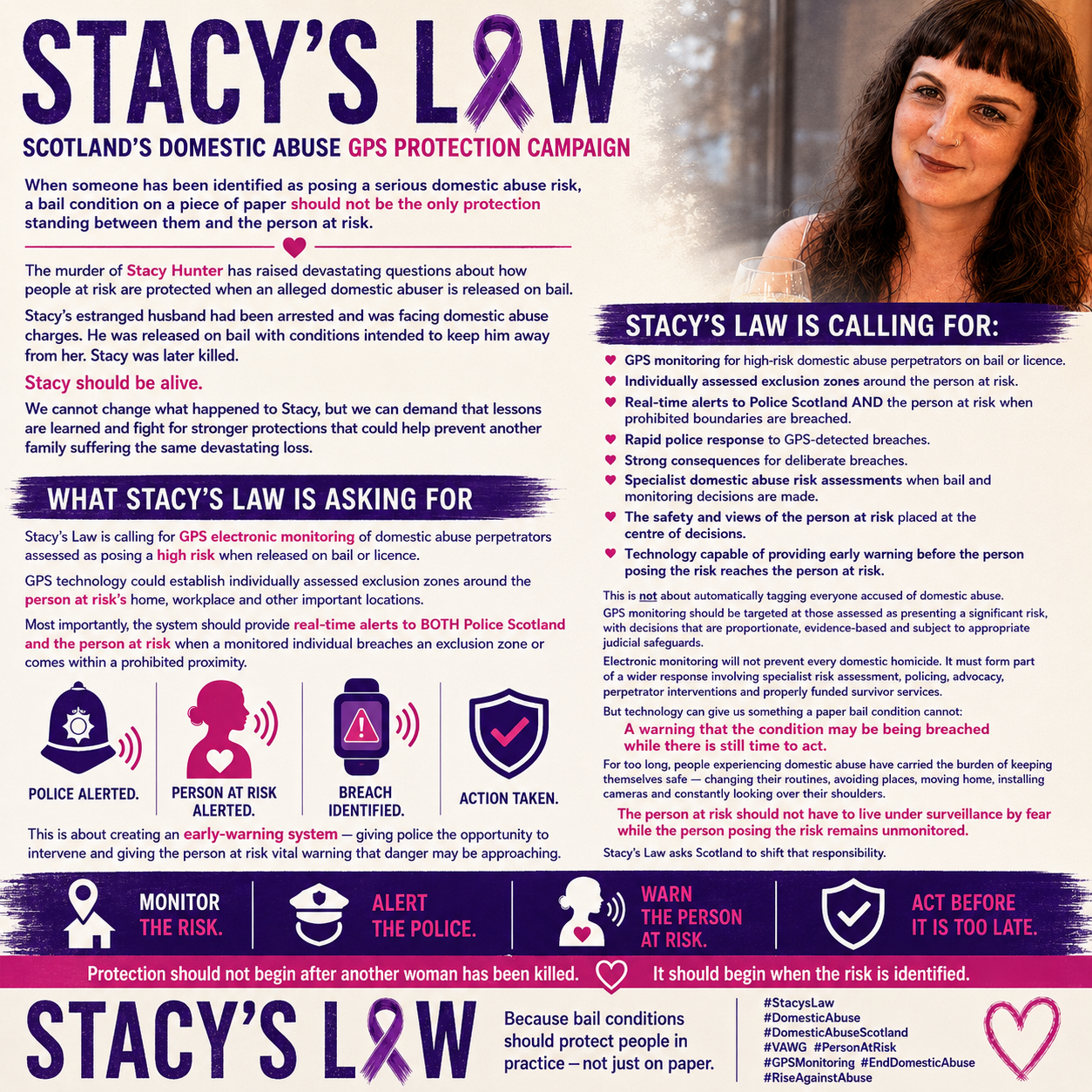
STACY’S LAW
Scotland’s Domestic Abuse GPS Protection Campaign
When someone has been identified as posing a serious domestic abuse risk, a bail condition on a piece of paper should not be the only protection standing between them and the person at risk.
The murder of Stacy Hunter has raised devastating questions about how people at risk are protected when an alleged domestic abuser is released on bail.
Stacy’s estranged husband had been arrested and was facing domestic abuse charges. He was released on bail with conditions intended to keep him away from her. Stacy was later killed.
Stacy should be alive.
We cannot change what happened to Stacy, but we can demand that lessons are learned and fight for stronger protections that could help prevent another family suffering the same devastating loss.
WHAT STACY’S LAW IS ASKING FOR
Stacy’s Law is calling for GPS electronic monitoring of domestic abuse perpetrators assessed as posing a high riskwhen released on bail or licence.
GPS technology could establish individually assessed exclusion zones around the person at risk’s home, workplace and other important locations.
Most importantly, the system should provide real-time alerts to BOTH Police Scotland and the person at risk when a monitored individual breaches an exclusion zone or comes within a prohibited proximity.
Police alerted.
Person at risk alerted.
Breach identified.
Action taken.
This is about creating an early-warning system — giving police the opportunity to intervene and giving the person at risk vital warning that danger may be approaching.
STACY’S LAW IS CALLING FOR:
GPS monitoring for high-risk domestic abuse perpetrators on bail or licence.
Individually assessed exclusion zones around the person at risk.
Real-time alerts to Police Scotland AND the person at risk when prohibited boundaries are breached.
Rapid police response to GPS-detected breaches.
Strong consequences for deliberate breaches.
Specialist domestic abuse risk assessments when bail and monitoring decisions are made.
The safety and views of the person at risk placed at the centre of decisions.
Technology capable of providing early warning before the person posing the risk reaches the person at risk.
This is not about automatically tagging everyone accused of domestic abuse.
GPS monitoring should be targeted at those assessed as presenting a significant risk, with decisions that are proportionate, evidence-based and subject to appropriate judicial safeguards.
Electronic monitoring will not prevent every domestic homicide. It must form part of a wider response involving specialist risk assessment, policing, advocacy, perpetrator interventions and properly funded survivor services.
But technology can give us something a paper bail condition cannot:
A warning that the condition may be being breached while there is still time to act.
For too long, people experiencing domestic abuse have carried the burden of keeping themselves safe — changing their routines, avoiding places, moving home, installing cameras and constantly looking over their shoulders.
The person at risk should not have to live under surveillance by fear while the person posing the risk remains unmonitored.
Stacy’s Law asks Scotland to shift that responsibility.
MONITOR THE RISK.
ALERT THE POLICE.
WARN THE PERSON AT RISK.
ACT BEFORE IT IS TOO LATE.
Protection should not begin after another woman has been killed.
It should begin when the risk is identified.
STACY’S LAW
Because bail conditions should protect people in practice — not just on paper.
#StacysLaw #DomesticAbuse #DomesticAbuseScotland #VAWG #PersonAtRisk #GPSMonitoring #EndDomesticAbuse #RiseAgainstAbuse

37,972
The Issue
STACY’S LAW
Scotland’s Domestic Abuse GPS Protection Campaign
When someone has been identified as posing a serious domestic abuse risk, a bail condition on a piece of paper should not be the only protection standing between them and the person at risk.
The murder of Stacy Hunter has raised devastating questions about how people at risk are protected when an alleged domestic abuser is released on bail.
Stacy’s estranged husband had been arrested and was facing domestic abuse charges. He was released on bail with conditions intended to keep him away from her. Stacy was later killed.
Stacy should be alive.
We cannot change what happened to Stacy, but we can demand that lessons are learned and fight for stronger protections that could help prevent another family suffering the same devastating loss.
WHAT STACY’S LAW IS ASKING FOR
Stacy’s Law is calling for GPS electronic monitoring of domestic abuse perpetrators assessed as posing a high riskwhen released on bail or licence.
GPS technology could establish individually assessed exclusion zones around the person at risk’s home, workplace and other important locations.
Most importantly, the system should provide real-time alerts to BOTH Police Scotland and the person at risk when a monitored individual breaches an exclusion zone or comes within a prohibited proximity.
Police alerted.
Person at risk alerted.
Breach identified.
Action taken.
This is about creating an early-warning system — giving police the opportunity to intervene and giving the person at risk vital warning that danger may be approaching.
STACY’S LAW IS CALLING FOR:
GPS monitoring for high-risk domestic abuse perpetrators on bail or licence.
Individually assessed exclusion zones around the person at risk.
Real-time alerts to Police Scotland AND the person at risk when prohibited boundaries are breached.
Rapid police response to GPS-detected breaches.
Strong consequences for deliberate breaches.
Specialist domestic abuse risk assessments when bail and monitoring decisions are made.
The safety and views of the person at risk placed at the centre of decisions.
Technology capable of providing early warning before the person posing the risk reaches the person at risk.
This is not about automatically tagging everyone accused of domestic abuse.
GPS monitoring should be targeted at those assessed as presenting a significant risk, with decisions that are proportionate, evidence-based and subject to appropriate judicial safeguards.
Electronic monitoring will not prevent every domestic homicide. It must form part of a wider response involving specialist risk assessment, policing, advocacy, perpetrator interventions and properly funded survivor services.
But technology can give us something a paper bail condition cannot:
A warning that the condition may be being breached while there is still time to act.
For too long, people experiencing domestic abuse have carried the burden of keeping themselves safe — changing their routines, avoiding places, moving home, installing cameras and constantly looking over their shoulders.
The person at risk should not have to live under surveillance by fear while the person posing the risk remains unmonitored.
Stacy’s Law asks Scotland to shift that responsibility.
MONITOR THE RISK.
ALERT THE POLICE.
WARN THE PERSON AT RISK.
ACT BEFORE IT IS TOO LATE.
Protection should not begin after another woman has been killed.
It should begin when the risk is identified.
STACY’S LAW
Because bail conditions should protect people in practice — not just on paper.
#StacysLaw #DomesticAbuse #DomesticAbuseScotland #VAWG #PersonAtRisk #GPSMonitoring #EndDomesticAbuse #RiseAgainstAbuse

Supporter Voices
Petition Updates
Share this petition
Petition created on 13 August 2026