

Effective Literacy Practices for BC
Effective Literacy Practices for BC
The Issue
With gratitude and respect, we acknowledge the unceded, shared traditional territories across British Columbia on whose lands we live, work and play.
The issue:
The ability to read and write proficiently is critical for positive life-outcomes in our print-driven world, but in BC schools, literacy practices are often not aligned with what decades of scientific evidence tells us about how the human brain learns to read and write. This is a systemic problem and it has a detrimental impact on students, society, and the economy.
This petition was started by a group of concerned BC citizens. Even if you aren’t directly involved in our education system, this is an issue every BC resident should be aware of. Read on to learn about why this issue isn’t an educational bandwagon or ideological pendulum swing. It’s about implementing science-informed, trauma-informed, culturally-responsive, effective instruction that’s beneficial for all, essential for many & harmful to none. Read, sign & share.
A Call to Action:
We, the undersigned group, comprised of BC parents and caregivers, school personnel (i.e. educational assistants, teachers, school psychologists, speech-language pathologists, school and district administrators), school board trustees, post-secondary faculty members, reading researchers and scientists, and other concerned citizens, respectfully request an external independent review of BC’s draft Literacy Learning Progressions (2023), the revised English Language Arts Curriculum (2016), and the revised Early Learning Framework (2019), with an end goal of aligning them with science-informed, trauma-informed, culturally-responsive, effective instruction so that ALL students can maximize their full potential, including, but not limited to, those who have Dyslexia.
Specifically, we are requesting:
- A language and literacy curriculum that is founded on scientific principles, focusing on explicit, systematic, and cumulative instruction in phonemic awareness, phonics, vocabulary, morphology, syntax, and reading comprehension.
- Removal of references to the three-cueing system and other aspects of balanced/comprehensive literacy that are rooted in unsupported whole language theory from the curriculum.
- A system of early identification (i.e., universal screeners) that also aligns with a Structured Literacy framework to determine those students at risk of further oral language, reading, and writing difficulties.
- Ongoing progress monitoring of literacy skills throughout the grades using scientifically-backed assessment tools in a timely and consistent manner.
- Resources, materials, and ongoing professional development aligned with the scientific evidence on literacy development for all teachers.
- Intensive intervention with empirically validated programs for children who continue to struggle with oral language, reading and/or writing.
- Pre-service teacher education, undergraduate and graduate level courses that align with the scientific evidence on literacy development and learning science.
Background:
- About 25% of Canadian children cannot read with expected proficiency by Grade 3 (Deloitte, 2020) and almost 50% of Canadian adults have inadequate literacy skills (Statistics Canada, 2015).
- Every 1% increase in literacy skills of adults creates an economic benefit of $67 billion gross domestic product as measured at 2018 prices (Deloitte, 2020).
- In addition to economic impacts, literacy skills are also linked to outcomes in the mental health and justice systems (Foundations Learning & Skills Saskatchewan, 2021).
- Fifty years of interdisciplinary scientific research indicates that 95%+ of students can be taught to read and write using a Structured Literacy approach (Hansford, 2023).
- Structured Literacy is characterized by the provision of systematic, explicit instruction that integrates listening, speaking, reading, and writing (IDA, 2023). It is also differentiated so that when students demonstrate mastery of specific skills, they move on.
- Other provinces including Ontario, Alberta, New Brunswick and the First Nation School Board in the Yukon (all 2023), Australia (2022), England (2022), and 31 states in the USA (Schwartz, 2023) are mandating the implementation of Structured Literacy.
BC Context:
- Despite the above information, the former BC Ministry of Education’s own internal Review (2000) and the Supreme Court of Canada ruling (Moore v. British Columbia, 2012), BC’s new draft Literacy Learning Progressions (2023), the revised English Language Arts Curriculum (2016), and the revised Early Learning Framework (2019) are not based on current, empirically-sound understandings of learning, language and literacy development.
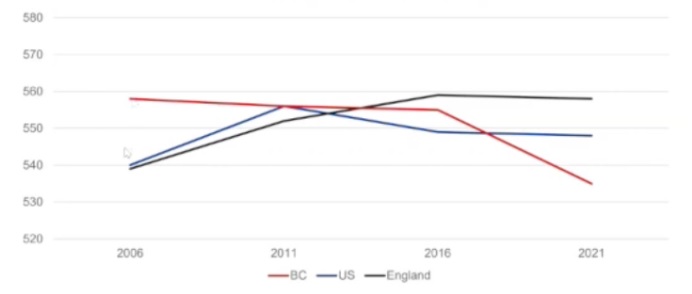
- Recent international data (IEA: PIRLS, 2021) indicates that BC literacy scores for grade 4 students are now lower and declining faster than the US and England:
- Our current Ministry of Education and Child Care (MoECC) has not recognized the Human Rights implications of a curriculum which is not aligned with scientific evidence on literacy development.
- Data presented in the How Are We Doing? Report (MoECC, 2022) indicates that students from marginalized populations, including Indigenous and exceptional learners, are still disproportionately underachieving in literacy.
- Structured Literacy is beneficial for all students who are developing foundational literacy skills and it is a trauma informed, culturally responsive approach that will effectively address the additional barriers faced by these and other marginalized populations (Dyslexia Canada, 2023).
- ALL BC students deserve equitable access to best practices in literacy teaching and learning as outlined in the Ontario Human Rights Commission’s Right to Read Inquiry Report (2022).
- Low literacy is a non-partisan human rights issue that impacts all British Columbians. Support for the urgent changes outlined in this petition from Members of the Legislative Assembly across British Columbia is greatly appreciated
Signatures from those outside of British Columbia are welcome; however, the intent is to present this petition to local Members of the Legislative Assembly (MLA), as MLAs can only consider matters presented by petitioners who are BC residents. To this end, we request that BC residents include their first and last name. You may uncheck 'display my name and comment on this petition' for privacy, if desired.
References:
Alberta Education. (2023). Literacy Progressions.
Australian Government. (2022). English Curriculum.
B.C. Ministry of Education. (2000). A Review of Special Education in British Columbia.
B.C. Ministry of Education. (2016). English Language Arts Curriculum.
B.C. Ministry of Education. (2019). Revised Early Learning Framework.
B.C. Ministry of Education and Child Care. (2022). ‘How Are We Doing?’ Report.
B.C. Ministry of Education and Child Care. (2023). Draft Literacy Learning Progressions.
Deloitte (2020). Children's Literacy and the Economy: insights from Deloitte's new analysis of low literacy in Canada.
Dyslexia Canada (2023). Barriers, Myths and Successes: A conversation among three experienced educators and teacher educators sharing perspectives and their work as a literacy improvement team in both provincial and First Nation school contexts.
England's Department for Education. (2022). The Reading Framework: Teaching the foundations of literacy.
First Nation School Board (Yukon). (2023). Literacy Plan.
Foundations Learning & Skills Saskatchewan. (2021). Impact of Low Literacy: The Canadian Context.
Government of New Brunswick. (2021). Research and Reading Instruction: Companion Document.
Hansford, N. (2023). Pedagogy Non Grata: Can 95% of Children Learn to Read?
International Association for the Evaluation of Educational Achievement (IEA). (2021). PIRLS (Progress in International Reading Literacy Study) data.
International Dyslexia Association. (2023). Structured Literacy Instruction.
Ontario Human Rights Commission. (2022). Right to Read Inquiry Report: executive summary.
Ontario Ministry of Education (2023). Language Curriculum.
Schwartz, S. (2023). Education Week: Which States Have Passed ‘Science of Reading’ Laws? What’s in Them?
Statistics Canada. (2015). Literacy, numeracy - Average scores and distribution of proficiency levels, by labour force status, highest level of education and age group.
Supreme Court of Canada. (2012). Supreme Court Judgments: Moore v. British Columbia (Education).

1,517
The Issue
With gratitude and respect, we acknowledge the unceded, shared traditional territories across British Columbia on whose lands we live, work and play.
The issue:
The ability to read and write proficiently is critical for positive life-outcomes in our print-driven world, but in BC schools, literacy practices are often not aligned with what decades of scientific evidence tells us about how the human brain learns to read and write. This is a systemic problem and it has a detrimental impact on students, society, and the economy.
This petition was started by a group of concerned BC citizens. Even if you aren’t directly involved in our education system, this is an issue every BC resident should be aware of. Read on to learn about why this issue isn’t an educational bandwagon or ideological pendulum swing. It’s about implementing science-informed, trauma-informed, culturally-responsive, effective instruction that’s beneficial for all, essential for many & harmful to none. Read, sign & share.
A Call to Action:
We, the undersigned group, comprised of BC parents and caregivers, school personnel (i.e. educational assistants, teachers, school psychologists, speech-language pathologists, school and district administrators), school board trustees, post-secondary faculty members, reading researchers and scientists, and other concerned citizens, respectfully request an external independent review of BC’s draft Literacy Learning Progressions (2023), the revised English Language Arts Curriculum (2016), and the revised Early Learning Framework (2019), with an end goal of aligning them with science-informed, trauma-informed, culturally-responsive, effective instruction so that ALL students can maximize their full potential, including, but not limited to, those who have Dyslexia.
Specifically, we are requesting:
- A language and literacy curriculum that is founded on scientific principles, focusing on explicit, systematic, and cumulative instruction in phonemic awareness, phonics, vocabulary, morphology, syntax, and reading comprehension.
- Removal of references to the three-cueing system and other aspects of balanced/comprehensive literacy that are rooted in unsupported whole language theory from the curriculum.
- A system of early identification (i.e., universal screeners) that also aligns with a Structured Literacy framework to determine those students at risk of further oral language, reading, and writing difficulties.
- Ongoing progress monitoring of literacy skills throughout the grades using scientifically-backed assessment tools in a timely and consistent manner.
- Resources, materials, and ongoing professional development aligned with the scientific evidence on literacy development for all teachers.
- Intensive intervention with empirically validated programs for children who continue to struggle with oral language, reading and/or writing.
- Pre-service teacher education, undergraduate and graduate level courses that align with the scientific evidence on literacy development and learning science.
Background:
- About 25% of Canadian children cannot read with expected proficiency by Grade 3 (Deloitte, 2020) and almost 50% of Canadian adults have inadequate literacy skills (Statistics Canada, 2015).
- Every 1% increase in literacy skills of adults creates an economic benefit of $67 billion gross domestic product as measured at 2018 prices (Deloitte, 2020).
- In addition to economic impacts, literacy skills are also linked to outcomes in the mental health and justice systems (Foundations Learning & Skills Saskatchewan, 2021).
- Fifty years of interdisciplinary scientific research indicates that 95%+ of students can be taught to read and write using a Structured Literacy approach (Hansford, 2023).
- Structured Literacy is characterized by the provision of systematic, explicit instruction that integrates listening, speaking, reading, and writing (IDA, 2023). It is also differentiated so that when students demonstrate mastery of specific skills, they move on.
- Other provinces including Ontario, Alberta, New Brunswick and the First Nation School Board in the Yukon (all 2023), Australia (2022), England (2022), and 31 states in the USA (Schwartz, 2023) are mandating the implementation of Structured Literacy.
BC Context:
- Despite the above information, the former BC Ministry of Education’s own internal Review (2000) and the Supreme Court of Canada ruling (Moore v. British Columbia, 2012), BC’s new draft Literacy Learning Progressions (2023), the revised English Language Arts Curriculum (2016), and the revised Early Learning Framework (2019) are not based on current, empirically-sound understandings of learning, language and literacy development.
- Recent international data (IEA: PIRLS, 2021) indicates that BC literacy scores for grade 4 students are now lower and declining faster than the US and England:
- Our current Ministry of Education and Child Care (MoECC) has not recognized the Human Rights implications of a curriculum which is not aligned with scientific evidence on literacy development.
- Data presented in the How Are We Doing? Report (MoECC, 2022) indicates that students from marginalized populations, including Indigenous and exceptional learners, are still disproportionately underachieving in literacy.
- Structured Literacy is beneficial for all students who are developing foundational literacy skills and it is a trauma informed, culturally responsive approach that will effectively address the additional barriers faced by these and other marginalized populations (Dyslexia Canada, 2023).
- ALL BC students deserve equitable access to best practices in literacy teaching and learning as outlined in the Ontario Human Rights Commission’s Right to Read Inquiry Report (2022).
- Low literacy is a non-partisan human rights issue that impacts all British Columbians. Support for the urgent changes outlined in this petition from Members of the Legislative Assembly across British Columbia is greatly appreciated
Signatures from those outside of British Columbia are welcome; however, the intent is to present this petition to local Members of the Legislative Assembly (MLA), as MLAs can only consider matters presented by petitioners who are BC residents. To this end, we request that BC residents include their first and last name. You may uncheck 'display my name and comment on this petition' for privacy, if desired.
References:
Alberta Education. (2023). Literacy Progressions.
Australian Government. (2022). English Curriculum.
B.C. Ministry of Education. (2000). A Review of Special Education in British Columbia.
B.C. Ministry of Education. (2016). English Language Arts Curriculum.
B.C. Ministry of Education. (2019). Revised Early Learning Framework.
B.C. Ministry of Education and Child Care. (2022). ‘How Are We Doing?’ Report.
B.C. Ministry of Education and Child Care. (2023). Draft Literacy Learning Progressions.
Deloitte (2020). Children's Literacy and the Economy: insights from Deloitte's new analysis of low literacy in Canada.
Dyslexia Canada (2023). Barriers, Myths and Successes: A conversation among three experienced educators and teacher educators sharing perspectives and their work as a literacy improvement team in both provincial and First Nation school contexts.
England's Department for Education. (2022). The Reading Framework: Teaching the foundations of literacy.
First Nation School Board (Yukon). (2023). Literacy Plan.
Foundations Learning & Skills Saskatchewan. (2021). Impact of Low Literacy: The Canadian Context.
Government of New Brunswick. (2021). Research and Reading Instruction: Companion Document.
Hansford, N. (2023). Pedagogy Non Grata: Can 95% of Children Learn to Read?
International Association for the Evaluation of Educational Achievement (IEA). (2021). PIRLS (Progress in International Reading Literacy Study) data.
International Dyslexia Association. (2023). Structured Literacy Instruction.
Ontario Human Rights Commission. (2022). Right to Read Inquiry Report: executive summary.
Ontario Ministry of Education (2023). Language Curriculum.
Schwartz, S. (2023). Education Week: Which States Have Passed ‘Science of Reading’ Laws? What’s in Them?
Statistics Canada. (2015). Literacy, numeracy - Average scores and distribution of proficiency levels, by labour force status, highest level of education and age group.
Supreme Court of Canada. (2012). Supreme Court Judgments: Moore v. British Columbia (Education).
1,517
Petition Updates
Share this petition
Petition created on July 7, 2023