

@NYTimes: Retract your "Mass Rape" stories used to Justify Killing Gazan Civilians
La causa
The NYTimes's articles on Hamas's WMR ("Weaponized Mass Rape") may turn out to function like the earlier Iraq WMD ("Weapons of Mass Destruction") articles in serving as a false justification for military action in Gaza.
- The Times should immediately retract the articles or respond to questions below.
SUMMARY:
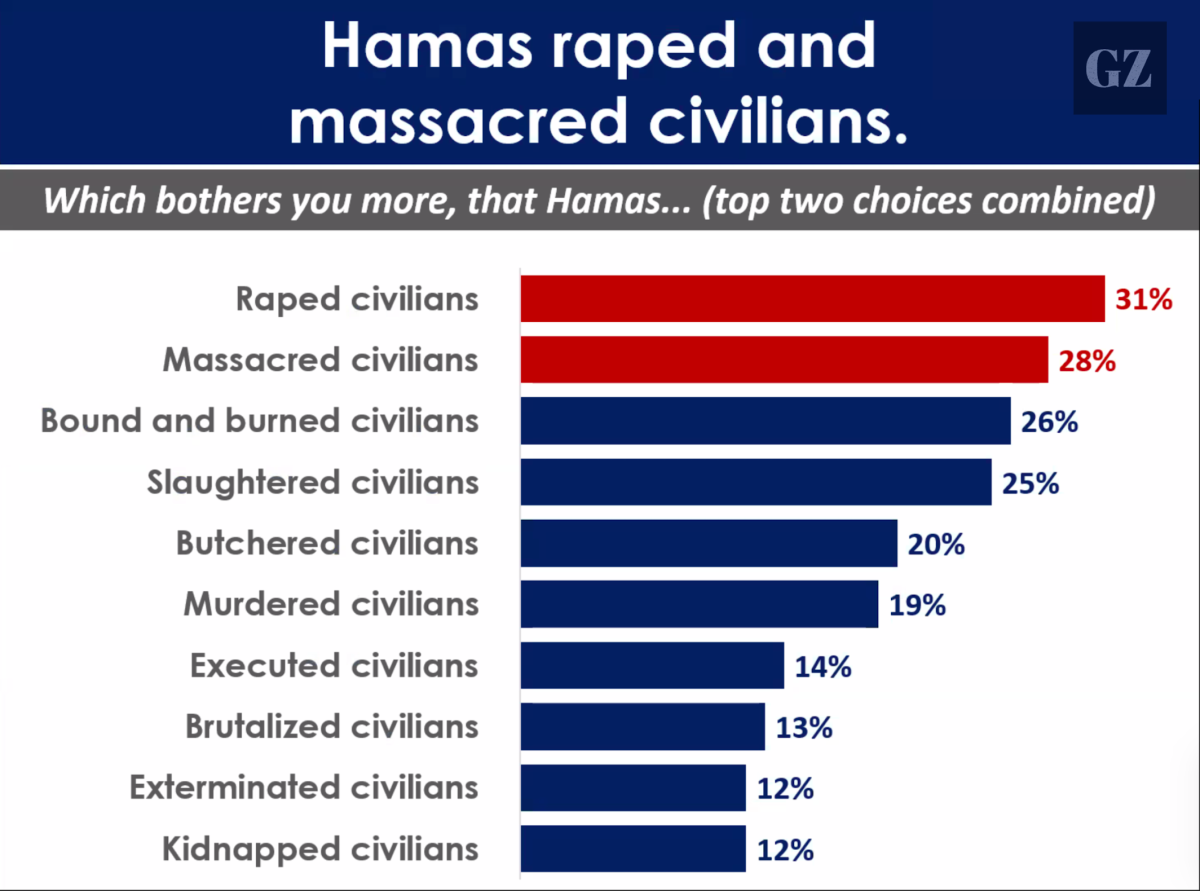
- Despite the fact that the New York Times story alleging "Mass Rapes" on Oct 7 has fallen apart under critical review, misconceptions of mass rape continue to be exploited by Israel supporters, as pollster Frank Luntz reports accusations of (widespread) rape are Israel's most potent argument in defense of its actions in Gaza.
- We must expose this misinformation so that allegations of rape can no longer be weaponized to excuse war crimes and suppress popular pressure on President Biden and Israel for starving Gazan civilians.
WHO NEEDS TO ACT:
- The New York Times (NYTimes)
DO WHAT: "RETRACT OR RESPOND"
- RETRACT: We call on the NYTimes to immediately retract their articles alleging "Hamas Weaponized Sexual Violence" using "mass rapes" ("dozens") so they can no longer be used to justify war crimes and starving Gazans.
- OR RESPOND: If the NYTimes is unwilling to immediately retract, we call on the Times to publish an article on this topic starting somewhere on the front page, with answers to our list of questions (found at the end of this page). These questions do not have to wait for an investigation to conclude, and include topics such as:
- the principles which guide the Times's decision whether to retract a story,
- their apparent censorship of stories involving Israel, and
- how much (or little) responsibility the Times takes for its articles. (see questions at the end of this page)
WHY:
The NYTimes made Inflammatory Charges with Deadly Consequences:
- Israel is using polling data from Frank Luntz that rape is the most effective way to justify Israel's actions in Gaza, echoing the Times' articles about Oct 7 "Mass Rape," despite the fact that the many of the claims, such as "mass rapes" ("dozens") have proven faulty or are poorly supported, and play on dehumanizing, racist, and colonial tropes.
- The article "played a central role in an Israeli campaign to criticize American feminist organizations and the U.N. for not siding with Israel in what had become an intense invasion of Gaza, which has in the months since since killed tens of thousands."
Justifying Israel's actions with poorly supported "mass rape" allegations suppresses righteous opposition to war crimes and starving Gazans that public (and Presidential) willpower could change.
- If we don't act, many "mainstream" media audiences will remain misinformed. Their tainted views will result in continued dehumanization of Palestinians and these audiences will remain vulnerable to manipulative poll-tested tactics so long as the Times resists retraction.
- It is important that the debunking of these claims happens quickly so that they can no longer be used to suppress popular pressure on President Biden to use his influence with Israel to stop civilian deaths and immediately let in civilian food, water, and medicine.
- President Biden must also recognize that his repetition of the false "beheaded babies" rumor contributed to the climate in which unfounded rumors were spread and retract his claims.
- Biden must also recognize and retract his Nov 16 charge regarding Hamas having their headquarters under al-Shifa hospital and "Hamas has already said publicly that they plan on attacking Israel again like they did before, to where they were cutting babies’ heads off to burn — burning women and children alive".
VIDEOS:
Original NYTimes Articles:
- What We Know About Sexual Violence During the Oct. 7 Attacks on Israel. New York Times. Dec 4, 2023.
- Screams without Words, New York Times. Dec 28, 2023.
Best "Mainstream" Articles:
- Between the Hammer and the Anvil, The Intercept. Feb 28, 2024.
- Kibbutz Be'eri Rejects Story in New York Times October 7 Expose: "They were not Sexually Abused", The Intercept. March 4, 2024.
Independent Summary:
- The New York Times Ignores Intense Scrutiny Of Its Oct. 7 Report, Defector. March 1, 2024.
- Owen Jones: Interview with journalist Richard Sanders (42 min video)
(See Original Reporting at bottom of the page)
Leaked Israel lobby presentation urges US officials to justify war on Gaza with ‘Hamas rape’ claims (Pollster Frank Luntz)
STORY DETAILS:
- Family members of the featured “victim,” Gal Abdush — "the woman in the black dress" — deny that she was raped, have instant messages suggesting otherwise, and said the reporter approached them under false pretenses and never mentioned that the topic of rape was even being considered for the article.
- The sposkesperson of Kibbutz Be'eri where the 13 and 16 year-old Sharabi sisters lived doesn't believe they were sexually abused and was recently contradicted by an Israeli soldier's video, according to a recent NYTimes article.
- A main “witness,” Raz Cohen, didn't report any rape when interviewed Aug 9 but appears to have taken photos at the time that suggest he was unconcerned that a rape was occurring and changed his story later. Despite the fact that he took selfies, he appears not to have taken any audio, photos, or videos that supported the claims he would later make much after the fact, when he changed his story.
- Other “witnesses” such as Sapir and Shari Mendes and those belonging to the ZAKA group lack credibility because they also fabricated things that we know didn't occur — such as beheaded babies and beheaded women. We know that these claims are false because all babies and women have been accounted for.
- Shari Mendes and Captain Maayan, who made graphic claims in the Times of seeing evidence of sexual violence, are now contradicted by a April 18 article in Haaretz by Liza Rozovsky: "there were no signs on any of the bodies attesting to sexual relations having taken place or of mutilation of genitalia."
- The NYTimes' own flagship podcast - "The Daily" refused to air the story as it was not able to meet their standards and the paper has not rewritten the story in a way that would be suitable for the podcast. It would be interesting to see the result if the Times rewrote the article because this would indicate what they believe can now be substantiated.
- There is no primary source evidence such as physical evidence or recordings supporting their claims. The Israelis say they have 60,000 video clips of evidence, but they couldn't present a single picture or frame that depicts rape, let alone mass rape.
- Anat Schwatz did not get multiple sources to confirm each claim, as lead author Jeffrey Gettleman had instructed her. If Hamas's actions were systemic or widespread, one wouldn't need to depend upon these compromised claims because solid evidence would have been easy to find.
- Israel's elite police investigative unit Lahav 433, which was leading the "sexual violence" investigations, and had 5 forensic pathologists, actually found "no signs of any of those bodies attesting to sexual relations having taken place or of mulitation of genitalia. Israeli media (Haaretz) (@zei_squirrel)
- In an interview with Israeli Army Radio, reporter Anat Schwartz said that when she was investigating sexual violence while surveying hospitals, rape crisis centers, trauma recovery facilities, and sex assault hotlines, she didn't find a single report of rape. (unverified Hebrew audio)
- Unable to locate evidence of mass rape, Schwartz fell back upon Israeli government officials and the "rescue group," ZAKA, which is the source of the debunked "40 beheaded babies" rumor.
- What does "weaponized" mean (in the article's headline)? How does this article show that Hamas "weaponized" sexual violence as opposed to alleged instance(s) of "non-weaponized" or "undisciplined" sexual violence? If there was sexual violence, how does the Times know it was committed by Hamas, rather than civilians who escaped through the Gaza wall, or was committed by some other group? This matters because rumors have circulated that Hamas instructed fighters to rape Israeli women, suggesting this was some sort of premeditated strategy, as has been alleged in the Democratic Republic of Congo.
- There are significant concerns about the two writers who collected the stories. Anat Schwarz had never worked as a journalist before, had liked a pro-genocide post on Twitter, liked a piece calling for comparing Hamas to ISIS for Israeli propaganda purposes, solicited a video of Gal Abdush (the woman in the black dress) from a photographer with the argument that publicizing the video would be good for Israeli hasbara (propaganda), and had worked for Israeli Air Force Intelligence. The other writer, Adam Sella, is Anat Schwarz's nephew by marriage, and had little professional writing experience except as a food writer.
QUESTIONS OF PRINCIPLE FOR THE NYTIMES TO ANSWER IMMEDIATELY, BEFORE AN INVESTIGATION IS COMPLETE:
- When scandals occur at the Times -- Judith Miller (Iraq WMD) and now Jeffrey Gettleman (WSV - weaponized sexual violence) -- both journalists describe their role as telling "stories", or providing "voice", or "information" without taking responsibility for vetting the sources for consistency or credibility. On a high profile story like this that can harm millions, what responsibility does the Times have for evaluating their sources or disclosing any conflicts of interests when the credibility of the evidence is in question?
- What would it take to warrant a retraction of this story?
- If you do not have strong evidence that there were “dozens” of rapes, as stated in one of your articles, would you retract?
- If, after an investigation, evidence of alleged featured rape victims such as Gal Abdush ("woman in the black dress") and the Sharabi sisters (update: NYT finds contradictoratry video) turns out to be in doubt , how many other claims would have to be put in doubt to warrant a retraction?
- Knowing what we now know, how would the Times assess the credibility/reliability of each of the sources in these articles?
- Is the Times more wary of (rape or WMD) allegations from governments with an agenda (such as war) and their referred sources than the Times would be of a non-aligned or motivated source (such as unaffiliated woman without an axe to grind)?
What would you say are the five strongest examples of rape? - Israel is reported to have 60,000 video clips of evidence. How many persuasive cases of rape would you expect to see evidence of if rape was widespread?
- Knowing what we know now, (before the investigation is complete) how many instances of rape do you think occurred on Oct 7? How many do you think there is strong evidence of?
- How does the Times avoid becoming complicit in government "Information Operations" (i.e. Propaganda) ?
- People have pointed out that your coverage of Israel seems to follow Israeli Military Censorship practices, for example, not attributing responsibility to Israel for attacks they performed unless Israel wants to accept responsibility, resulting in the Times using a lot of "passive voice." Headlines involving Israel seem to follow a different format than headlines involving the US. Is the Times doing this sort of obfuscation voluntarily or as a requirement of Israeli censorship?
- How important is it that headlines are factually supported by the article? We know that many people only read headlines and skim, and would be misled by unsupported headlines.
- Does the Times consider the overall effect of a story on public opinion & policy based upon headlines and circulation in the news cycle when considering a retraction?
- What would constitute evidence of “weaponizing sexual violence,” as opposed to "non-weaponized?"
- Are you concerned that readers will lose trust in the Times if awareness of Times censorship is more broadly known or suspected? Have you disclosed to readers the different way you treat Israeli and US military operations in the Middle East? Is this a result of policy? Would you be willing to publish an article or articles describing for readers how practices differ in regard to Israel and why?
- Given that:
- Israel is using Frank Luntz's polling to target accusations of "rape" as a justification for Israel’s actions in Gaza because Luntz has determined that allegations of rape are the most potent argument Isreal and its supporters can make to justify their actions in Gaza,
- rape allegations have a deep history of being used as racial and colonial tropes,
- what ought to be the standard of evidence required for an article airing these types of allegations on the front page of the New York Times?
- Is the Times cognizant of the history of atrocity propaganda? What strategies does it have to avoid becoming a carrier of it?
- Are the Times writers familiar with the way the body reacts after death, possibly affecting the position the body is found in later on?
- Why did you use such inexperienced “journalists” for this story? Is the New York Times unable to find experienced journalists for such a sensitive story even though you might anticipate it may be featured on the front page? If the Times is unable to find experienced journalists for sensitive stories, is it a good idea for the Times to attempt them (Is it reckless?) knowing how many people's lives may be put at risk?
- How were Anat Schwartz selected/hired to do this reporting and who were responsible for the selection? Who suggested the story idea and who promoted it within the Times?
- After investigating mass rapes while surveying hospitals, rape crisis centers, trauma recovery facilities, and sex assault hotlines, Anat Schwartz didn't find a single report of rape. What sort of findings would have prompted the NYTimes to reassess its assumptions and reconsider plans for the story?
- The Times has put significant resources into investigating sexual violence on Oct 7. Why has it not put more effort into bringing to public awareness reports that Israel tried to prevent the taking of hostages at the cost of killing their own civilians (The Hannibal directive)? This policy has been acknowledged by the Times in the past. Wouldn't reports that Israel is applying the Hannibal directive to civilians be both newsworthy, and have the benefit of informing Americans who it was that burned so many cars, bodies, and residences on October 7? As late as March 22, 2024,
- US UN representative Linda Thomas Greenfield recently promoted the idea that Russia and China would not condemn Hamas's "burning people alive" and "raping women and girls".
- Isreal's UN representative Gilad Erdan also gave the charge of rape high billing.
- What fraction of Times readers are aware that many/most burned Israeli "babies", vehicles, and buildings appear to have been burned by helicopter or tank fire? Is there an official or unofficial policy preventing this type of information from being published prominently?
NOTE:
Hamas did commit atrocities on Oct 7. Rape and sexual violence are assumed to be common during wars, prompting many to accept any claims that are made about this one-day event. The original NYTimes article alleged “dozens” of rapes used in a systemic way as a "weapon" of war. This is not "Me too" (except for Jews). We’re not being asked to believe "women," or credible witnesses, or 60,000 video clips, but rather government officials and their referred witnesses whose stories show signs of unreliability, such as alleging beheaded babies.
UPDATE: SHERYL SANDERS & BRIAHNA JOY GRAY:
(Briahna believes she was fired for Israel coverage)
UPDATE: UN Report
"What Pramila Patten’s UN report on Oct 7 sexual violence actually said." openpolitics.com, Tim Langeman (Petition creator)
Ro Khanna Interview (Widely Misunderstood)
UN Report: Misrepresented: No Evidence
Oct 7 Documentary: ZAKA | UN Report | Video Contents
Owen Jones Interviews Richard Sanders about his documentary
CREDIT: FOR ORIGINAL REPORTING:
Original reporting by Electronic Intifada, The Grayzone, and Mondoweiss.
- Electronic Intifada: Mass Rape Accusation Ali Abunimah, Asa Winstanley, Electronic Intifada. starting Dec 4, 2023
- Despite lack of evidence, allegations of Hamas ‘mass rape’ are fueling Israeli genocide in Gaza, Kareena Pannu, Mondoweiss, Dec 8, 2023
- Screams without proof: questions for NYT about shoddy ‘Hamas mass rape’ report, Max Blumenthal and Aaron Maté, The Grayzone, Jan 10, 2024
- New Israeli report alleging ‘systematic and intentional rape’ by Hamas relies on debunked Western media reports, Max Blumenthal, The Grayzone, Feb 22, 2024
A COUNTER ARGUMENT:
- The New Rape Denialism, New York Times, Bret Stephens.

Petición Cerrada
La causa
The NYTimes's articles on Hamas's WMR ("Weaponized Mass Rape") may turn out to function like the earlier Iraq WMD ("Weapons of Mass Destruction") articles in serving as a false justification for military action in Gaza.
- The Times should immediately retract the articles or respond to questions below.
SUMMARY:
- Despite the fact that the New York Times story alleging "Mass Rapes" on Oct 7 has fallen apart under critical review, misconceptions of mass rape continue to be exploited by Israel supporters, as pollster Frank Luntz reports accusations of (widespread) rape are Israel's most potent argument in defense of its actions in Gaza.
- We must expose this misinformation so that allegations of rape can no longer be weaponized to excuse war crimes and suppress popular pressure on President Biden and Israel for starving Gazan civilians.
WHO NEEDS TO ACT:
- The New York Times (NYTimes)
DO WHAT: "RETRACT OR RESPOND"
- RETRACT: We call on the NYTimes to immediately retract their articles alleging "Hamas Weaponized Sexual Violence" using "mass rapes" ("dozens") so they can no longer be used to justify war crimes and starving Gazans.
- OR RESPOND: If the NYTimes is unwilling to immediately retract, we call on the Times to publish an article on this topic starting somewhere on the front page, with answers to our list of questions (found at the end of this page). These questions do not have to wait for an investigation to conclude, and include topics such as:
- the principles which guide the Times's decision whether to retract a story,
- their apparent censorship of stories involving Israel, and
- how much (or little) responsibility the Times takes for its articles. (see questions at the end of this page)
WHY:
The NYTimes made Inflammatory Charges with Deadly Consequences:
- Israel is using polling data from Frank Luntz that rape is the most effective way to justify Israel's actions in Gaza, echoing the Times' articles about Oct 7 "Mass Rape," despite the fact that the many of the claims, such as "mass rapes" ("dozens") have proven faulty or are poorly supported, and play on dehumanizing, racist, and colonial tropes.
- The article "played a central role in an Israeli campaign to criticize American feminist organizations and the U.N. for not siding with Israel in what had become an intense invasion of Gaza, which has in the months since since killed tens of thousands."
Justifying Israel's actions with poorly supported "mass rape" allegations suppresses righteous opposition to war crimes and starving Gazans that public (and Presidential) willpower could change.
- If we don't act, many "mainstream" media audiences will remain misinformed. Their tainted views will result in continued dehumanization of Palestinians and these audiences will remain vulnerable to manipulative poll-tested tactics so long as the Times resists retraction.
- It is important that the debunking of these claims happens quickly so that they can no longer be used to suppress popular pressure on President Biden to use his influence with Israel to stop civilian deaths and immediately let in civilian food, water, and medicine.
- President Biden must also recognize that his repetition of the false "beheaded babies" rumor contributed to the climate in which unfounded rumors were spread and retract his claims.
- Biden must also recognize and retract his Nov 16 charge regarding Hamas having their headquarters under al-Shifa hospital and "Hamas has already said publicly that they plan on attacking Israel again like they did before, to where they were cutting babies’ heads off to burn — burning women and children alive".
VIDEOS:
Original NYTimes Articles:
- What We Know About Sexual Violence During the Oct. 7 Attacks on Israel. New York Times. Dec 4, 2023.
- Screams without Words, New York Times. Dec 28, 2023.
Best "Mainstream" Articles:
- Between the Hammer and the Anvil, The Intercept. Feb 28, 2024.
- Kibbutz Be'eri Rejects Story in New York Times October 7 Expose: "They were not Sexually Abused", The Intercept. March 4, 2024.
Independent Summary:
- The New York Times Ignores Intense Scrutiny Of Its Oct. 7 Report, Defector. March 1, 2024.
- Owen Jones: Interview with journalist Richard Sanders (42 min video)
(See Original Reporting at bottom of the page)
Leaked Israel lobby presentation urges US officials to justify war on Gaza with ‘Hamas rape’ claims (Pollster Frank Luntz)
STORY DETAILS:
- Family members of the featured “victim,” Gal Abdush — "the woman in the black dress" — deny that she was raped, have instant messages suggesting otherwise, and said the reporter approached them under false pretenses and never mentioned that the topic of rape was even being considered for the article.
- The sposkesperson of Kibbutz Be'eri where the 13 and 16 year-old Sharabi sisters lived doesn't believe they were sexually abused and was recently contradicted by an Israeli soldier's video, according to a recent NYTimes article.
- A main “witness,” Raz Cohen, didn't report any rape when interviewed Aug 9 but appears to have taken photos at the time that suggest he was unconcerned that a rape was occurring and changed his story later. Despite the fact that he took selfies, he appears not to have taken any audio, photos, or videos that supported the claims he would later make much after the fact, when he changed his story.
- Other “witnesses” such as Sapir and Shari Mendes and those belonging to the ZAKA group lack credibility because they also fabricated things that we know didn't occur — such as beheaded babies and beheaded women. We know that these claims are false because all babies and women have been accounted for.
- Shari Mendes and Captain Maayan, who made graphic claims in the Times of seeing evidence of sexual violence, are now contradicted by a April 18 article in Haaretz by Liza Rozovsky: "there were no signs on any of the bodies attesting to sexual relations having taken place or of mutilation of genitalia."
- The NYTimes' own flagship podcast - "The Daily" refused to air the story as it was not able to meet their standards and the paper has not rewritten the story in a way that would be suitable for the podcast. It would be interesting to see the result if the Times rewrote the article because this would indicate what they believe can now be substantiated.
- There is no primary source evidence such as physical evidence or recordings supporting their claims. The Israelis say they have 60,000 video clips of evidence, but they couldn't present a single picture or frame that depicts rape, let alone mass rape.
- Anat Schwatz did not get multiple sources to confirm each claim, as lead author Jeffrey Gettleman had instructed her. If Hamas's actions were systemic or widespread, one wouldn't need to depend upon these compromised claims because solid evidence would have been easy to find.
- Israel's elite police investigative unit Lahav 433, which was leading the "sexual violence" investigations, and had 5 forensic pathologists, actually found "no signs of any of those bodies attesting to sexual relations having taken place or of mulitation of genitalia. Israeli media (Haaretz) (@zei_squirrel)
- In an interview with Israeli Army Radio, reporter Anat Schwartz said that when she was investigating sexual violence while surveying hospitals, rape crisis centers, trauma recovery facilities, and sex assault hotlines, she didn't find a single report of rape. (unverified Hebrew audio)
- Unable to locate evidence of mass rape, Schwartz fell back upon Israeli government officials and the "rescue group," ZAKA, which is the source of the debunked "40 beheaded babies" rumor.
- What does "weaponized" mean (in the article's headline)? How does this article show that Hamas "weaponized" sexual violence as opposed to alleged instance(s) of "non-weaponized" or "undisciplined" sexual violence? If there was sexual violence, how does the Times know it was committed by Hamas, rather than civilians who escaped through the Gaza wall, or was committed by some other group? This matters because rumors have circulated that Hamas instructed fighters to rape Israeli women, suggesting this was some sort of premeditated strategy, as has been alleged in the Democratic Republic of Congo.
- There are significant concerns about the two writers who collected the stories. Anat Schwarz had never worked as a journalist before, had liked a pro-genocide post on Twitter, liked a piece calling for comparing Hamas to ISIS for Israeli propaganda purposes, solicited a video of Gal Abdush (the woman in the black dress) from a photographer with the argument that publicizing the video would be good for Israeli hasbara (propaganda), and had worked for Israeli Air Force Intelligence. The other writer, Adam Sella, is Anat Schwarz's nephew by marriage, and had little professional writing experience except as a food writer.
QUESTIONS OF PRINCIPLE FOR THE NYTIMES TO ANSWER IMMEDIATELY, BEFORE AN INVESTIGATION IS COMPLETE:
- When scandals occur at the Times -- Judith Miller (Iraq WMD) and now Jeffrey Gettleman (WSV - weaponized sexual violence) -- both journalists describe their role as telling "stories", or providing "voice", or "information" without taking responsibility for vetting the sources for consistency or credibility. On a high profile story like this that can harm millions, what responsibility does the Times have for evaluating their sources or disclosing any conflicts of interests when the credibility of the evidence is in question?
- What would it take to warrant a retraction of this story?
- If you do not have strong evidence that there were “dozens” of rapes, as stated in one of your articles, would you retract?
- If, after an investigation, evidence of alleged featured rape victims such as Gal Abdush ("woman in the black dress") and the Sharabi sisters (update: NYT finds contradictoratry video) turns out to be in doubt , how many other claims would have to be put in doubt to warrant a retraction?
- Knowing what we now know, how would the Times assess the credibility/reliability of each of the sources in these articles?
- Is the Times more wary of (rape or WMD) allegations from governments with an agenda (such as war) and their referred sources than the Times would be of a non-aligned or motivated source (such as unaffiliated woman without an axe to grind)?
What would you say are the five strongest examples of rape? - Israel is reported to have 60,000 video clips of evidence. How many persuasive cases of rape would you expect to see evidence of if rape was widespread?
- Knowing what we know now, (before the investigation is complete) how many instances of rape do you think occurred on Oct 7? How many do you think there is strong evidence of?
- How does the Times avoid becoming complicit in government "Information Operations" (i.e. Propaganda) ?
- People have pointed out that your coverage of Israel seems to follow Israeli Military Censorship practices, for example, not attributing responsibility to Israel for attacks they performed unless Israel wants to accept responsibility, resulting in the Times using a lot of "passive voice." Headlines involving Israel seem to follow a different format than headlines involving the US. Is the Times doing this sort of obfuscation voluntarily or as a requirement of Israeli censorship?
- How important is it that headlines are factually supported by the article? We know that many people only read headlines and skim, and would be misled by unsupported headlines.
- Does the Times consider the overall effect of a story on public opinion & policy based upon headlines and circulation in the news cycle when considering a retraction?
- What would constitute evidence of “weaponizing sexual violence,” as opposed to "non-weaponized?"
- Are you concerned that readers will lose trust in the Times if awareness of Times censorship is more broadly known or suspected? Have you disclosed to readers the different way you treat Israeli and US military operations in the Middle East? Is this a result of policy? Would you be willing to publish an article or articles describing for readers how practices differ in regard to Israel and why?
- Given that:
- Israel is using Frank Luntz's polling to target accusations of "rape" as a justification for Israel’s actions in Gaza because Luntz has determined that allegations of rape are the most potent argument Isreal and its supporters can make to justify their actions in Gaza,
- rape allegations have a deep history of being used as racial and colonial tropes,
- what ought to be the standard of evidence required for an article airing these types of allegations on the front page of the New York Times?
- Is the Times cognizant of the history of atrocity propaganda? What strategies does it have to avoid becoming a carrier of it?
- Are the Times writers familiar with the way the body reacts after death, possibly affecting the position the body is found in later on?
- Why did you use such inexperienced “journalists” for this story? Is the New York Times unable to find experienced journalists for such a sensitive story even though you might anticipate it may be featured on the front page? If the Times is unable to find experienced journalists for sensitive stories, is it a good idea for the Times to attempt them (Is it reckless?) knowing how many people's lives may be put at risk?
- How were Anat Schwartz selected/hired to do this reporting and who were responsible for the selection? Who suggested the story idea and who promoted it within the Times?
- After investigating mass rapes while surveying hospitals, rape crisis centers, trauma recovery facilities, and sex assault hotlines, Anat Schwartz didn't find a single report of rape. What sort of findings would have prompted the NYTimes to reassess its assumptions and reconsider plans for the story?
- The Times has put significant resources into investigating sexual violence on Oct 7. Why has it not put more effort into bringing to public awareness reports that Israel tried to prevent the taking of hostages at the cost of killing their own civilians (The Hannibal directive)? This policy has been acknowledged by the Times in the past. Wouldn't reports that Israel is applying the Hannibal directive to civilians be both newsworthy, and have the benefit of informing Americans who it was that burned so many cars, bodies, and residences on October 7? As late as March 22, 2024,
- US UN representative Linda Thomas Greenfield recently promoted the idea that Russia and China would not condemn Hamas's "burning people alive" and "raping women and girls".
- Isreal's UN representative Gilad Erdan also gave the charge of rape high billing.
- What fraction of Times readers are aware that many/most burned Israeli "babies", vehicles, and buildings appear to have been burned by helicopter or tank fire? Is there an official or unofficial policy preventing this type of information from being published prominently?
NOTE:
Hamas did commit atrocities on Oct 7. Rape and sexual violence are assumed to be common during wars, prompting many to accept any claims that are made about this one-day event. The original NYTimes article alleged “dozens” of rapes used in a systemic way as a "weapon" of war. This is not "Me too" (except for Jews). We’re not being asked to believe "women," or credible witnesses, or 60,000 video clips, but rather government officials and their referred witnesses whose stories show signs of unreliability, such as alleging beheaded babies.
UPDATE: SHERYL SANDERS & BRIAHNA JOY GRAY:
(Briahna believes she was fired for Israel coverage)
UPDATE: UN Report
"What Pramila Patten’s UN report on Oct 7 sexual violence actually said." openpolitics.com, Tim Langeman (Petition creator)
Ro Khanna Interview (Widely Misunderstood)
UN Report: Misrepresented: No Evidence
Oct 7 Documentary: ZAKA | UN Report | Video Contents
Owen Jones Interviews Richard Sanders about his documentary
CREDIT: FOR ORIGINAL REPORTING:
Original reporting by Electronic Intifada, The Grayzone, and Mondoweiss.
- Electronic Intifada: Mass Rape Accusation Ali Abunimah, Asa Winstanley, Electronic Intifada. starting Dec 4, 2023
- Despite lack of evidence, allegations of Hamas ‘mass rape’ are fueling Israeli genocide in Gaza, Kareena Pannu, Mondoweiss, Dec 8, 2023
- Screams without proof: questions for NYT about shoddy ‘Hamas mass rape’ report, Max Blumenthal and Aaron Maté, The Grayzone, Jan 10, 2024
- New Israeli report alleging ‘systematic and intentional rape’ by Hamas relies on debunked Western media reports, Max Blumenthal, The Grayzone, Feb 22, 2024
A COUNTER ARGUMENT:
- The New Rape Denialism, New York Times, Bret Stephens.
Los tomadores de decisiones

Las voces de los firmantes
Actualizaciones de la petición
Compartir esta petición
Petición creada en 10 de marzo de 2024