

Stop Improper ADU Sewer Fees — Demand Fair and Transparent Charges.
The Issue
The Issue
Ojai Valley homeowners report being charged thousands of dollars in sewer capacity fees when they build an accessory dwelling unit (ADU). Some say their ADU connects through the property's existing private sewer lateral, without a new, separate connection directly to the public sewer system.
Homeowners also report that charges were not clearly disclosed before construction, arrived after work began or was completed, or were later placed on property-tax bills.
These charges raise fundamental questions about fairness, transparency, and compliance with California's ADU laws.
November 19, 2026 Update — OVSD Board Votes to Publicize HCD Letter While Fee Questions Remain Unanswered
At its November 19 Special Board Meeting, the Ojai Valley Sanitary District (OVSD) Board voted to publish a November 2, 2026 letter from the California Department of Housing and Community Development (HCD) and distribute it to local news organizations with an accompanying District-written cover letter.
District representatives presented the letter as resolving the dispute over whether capacity charges may apply when an ADU connects through an existing private sewer lateral.
However, HCD's letter does not establish that OVSD's actual capacity charges comply with California law.
HCD states that capacity charges may be permissible for direct or indirect connections, provided they are proportionate to the ADU's burden and do not exceed the reasonable cost of providing service.
The letter does not demonstrate that HCD independently examined OVSD's actual capacity-fee calculations, its 25-drainage-fixture-unit (DFU) baseline, or individual homeowner assessments.
Why the Board's Decision Raises Questions
During public comment, ADU Rights reminded the Board that its directors had previously requested more definitive guidance from HCD before taking action.
HCD's November 23, 2020 Technical Assistance Letter was signed by its Land Use and Planning Unit Chief, copied to the California Department of Justice, and remains publicly available in HCD's records.
The November 2, 2026 letter was signed by the ADU Policy Section Chief, was not copied to the Attorney General, and had not been identified on HCD's public Technical Assistance and Enforcement Letters Dashboard during our latest review.
These differences do not invalidate the newer letter. However, the November 2 letter says it supersedes prior informal guidance without expressly identifying the formal November 2020 Technical Assistance Letter as withdrawn or superseded.
During the meeting, a director characterized the newer letter as superseding all previous correspondence and treated the matter as settled.
The Board's vote authorizes publication of a letter. It does not establish that OVSD's actual charges satisfy the statutory requirements.
ADU Rights asked the Board to obtain clarification from HCD, publish the complete history of relevant HCD correspondence, and publicly substantiate the calculations supporting its fees.
The Board approved publication without resolving those requests during the recorded discussion.
The petition therefore remains active. The underlying questions about how these fees are calculated, justified, and disclosed have not been answered.
The Fee Comparison — Why Homeowners Are Concerned
The following comparison illustrates why homeowners are asking OVSD to explain its capacity-fee methodology and recurring sewer-service charges.
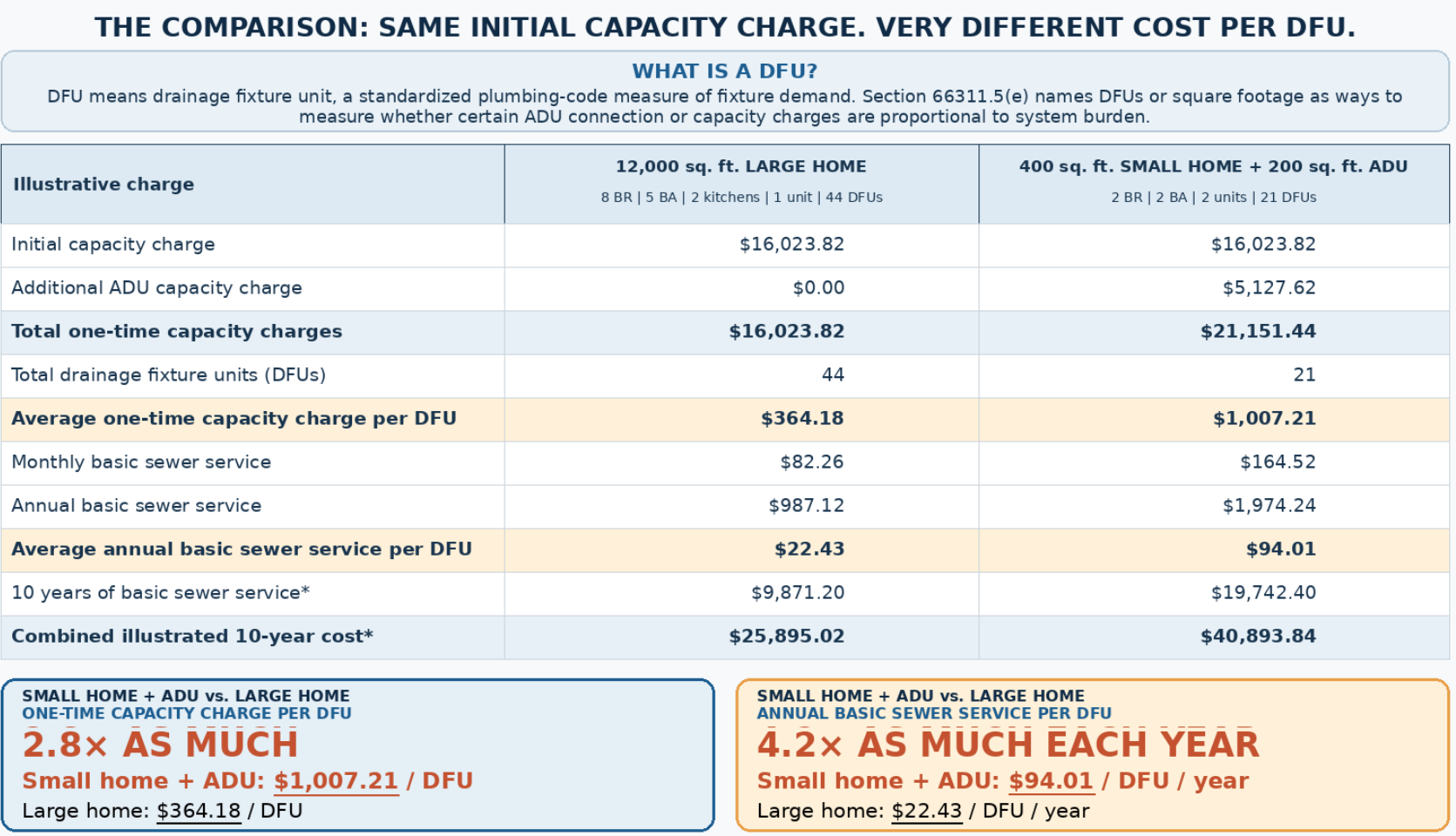
This is an illustrative comparison using the charges and fixture counts shown. The per-DFU figures are averages for comparison; OVSD's annual sewer-service charges are assessed by service unit. The 10-year figures assume the listed annual rates remain unchanged. The comparison raises questions about the fee method; it is not a judicial finding that a charge is unlawful.
What the Comparison Shows
In the example, a 12,000-square-foot home with 44 drainage fixture units (DFUs) and a 400-square-foot home with a 200-square-foot ADU and 21 DFUs are assigned the same initial capacity charge.
The small home and ADU then face an additional ADU capacity charge and a second annual sewer-service charge.
OVSD's initial residential capacity charge is generally based on a standard charge rather than being individually scaled to the home's square footage or DFUs.
For an added ADU, however, OVSD calculates an additional capacity charge using the ADU's DFUs.
This creates an apparent disparity: the much smaller property can incur higher total capacity charges despite having fewer plumbing fixtures.
That difference raises fair questions:
What capacity did the original charge assign to the property?
How is that previously paid capacity considered when an ADU is added?
What evidence shows that the additional charge reflects the ADU's burden on the sewer system?
How does OVSD demonstrate that the charge does not exceed reasonable cost?
Why is the initial residential charge generally standardized while the additional ADU charge is calculated proportionately using DFUs?
A private lateral's ability to carry more wastewater does not, by itself, establish that the public system has no additional demand.
But the existence of additional demand does not, by itself, establish that a particular charge is proportionate or justified.
OVSD should be able to explain its methodology and support it with documented engineering and financial evidence.
What California Law and HCD Have Said
Government Code § 66311.5 establishes different requirements for different ADU categories.
Subdivision (d) limits when a local agency may require certain qualifying ADUs to install a new or separate direct utility connection or pay a related connection fee or capacity charge.
Subdivision (e) addresses other ADUs, for which a new or separate direct connection may be required; a related charge must be proportionate to the ADU's burden and cannot exceed reasonable cost.
On November 2, 2026, HCD told OVSD that capacity charges may apply to certain ADUs even when they connect through an existing private lateral, provided the charges meet applicable proportionality and reasonable-cost requirements.
This differs from HCD's June 6, 2026 correspondence and its November 23, 2020 Technical Assistance Letter.
HCD described its November interpretation as superseding prior informal guidance.
ADU Rights disagrees with HCD's revised interpretation and seeks clarification about its application to ADUs using existing laterals, including how the November 2 letter relates to the earlier formal Technical Assistance Letter.
Importantly, the November letter does not determine whether OVSD's calculations in any particular case meet the stated requirements.
Read the HCD correspondence
November 2, 2026 — HCD Letter of Technical Assistance to OVSD
June 6, 2026 — HCD correspondence regarding direct connections
November 23, 2020 — HCD Technical Assistance Letter
Ongoing Sewer-Service Charges — A Separate Financial Burden
Annual sewer-service charges are separate from one-time capacity charges.
Under OVSD's rate structure, some ADUs may be assessed an additional full residential service charge, even when the ADU is considerably smaller than the primary home.
The comparison chart illustrates how a small home with an ADU can pay twice the basic annual sewer-service charge of a much larger home with only one dwelling.
These charges recur year after year.
Homeowners deserve to understand how OVSD determines its number of service units, what costs each charge covers, and why a small ADU should be assigned an additional full residential service unit rather than a charge more closely related to its demand.
Two dwelling units can impose costs that are not necessarily proportional to square footage or fixture counts. But that does not eliminate the District's responsibility to explain and substantiate the cost allocation.
Recurring sewer-service charges require a separate cost-of-service explanation and cannot be justified solely by HCD's November 2 discussion of ADU capacity charges.
What We Are Asking
We ask the appropriate state and local authorities to:
Review OVSD's ADU capacity-charge practices and clarify how California law applies to direct and indirect sewer connections, including the relationship between HCD's 2020 and 2026 guidance.
Require public disclosure of OVSD's capacity-charge methodology, including the 25-DFU baseline, calculation of incremental ADU charges, and accounting for capacity previously assigned to a property.
Require documented justification for proportionality and reasonable cost, supported by the engineering and financial information needed to evaluate the charges.
Review the basis for additional annual sewer-service charges, including the service-unit methodology and cost allocations that result in some ADUs being charged a second full residential service fee.
Ensure clear, itemized disclosure before construction, so homeowners understand their expected capacity and ongoing sewer-service charges before committing to an ADU project.
Review disputed assessments and provide appropriate corrective action, including refunds, credits, or adjustments where particular charges are found to have been improperly imposed.
Establish clear, consistent statewide requirements so homeowners can determine what utility charges may lawfully apply before building an ADU.
Why This Matters
Accessory dwelling units help families house aging parents, provide homes for adult children, create rental housing, and manage rising housing costs.
California has encouraged their construction by removing unnecessary barriers and making small-scale residential development more practical.
Homeowners should pay their fair share of public infrastructure costs where authorized by law.
But they should not face unexplained, inconsistent, or unsupported charges simply because they choose to build an ADU.
Whether a charge is permissible depends on the type of ADU, applicable law, connection requirements, fee methodology, and property-specific facts.
The November 19 Board meeting did not resolve these questions.
Transparency and demonstrated compliance—not simply a favorable interpretation of an agency letter—are necessary to establish whether these charges are justified.
Support Fair and Transparent ADU Sewer Fees
Sign this petition and share it with your neighbors.
If you built or proposed an ADU in the Ojai Valley and received an OVSD capacity charge, we would like to hear what happened.
Contact ADU Rights:
We will not publicly share your name or personal story without your permission.
This petition addresses public policy and disputed legal interpretations. No judicial determination that the challenged OVSD practices are unlawful is asserted here.

68
The Issue
The Issue
Ojai Valley homeowners report being charged thousands of dollars in sewer capacity fees when they build an accessory dwelling unit (ADU). Some say their ADU connects through the property's existing private sewer lateral, without a new, separate connection directly to the public sewer system.
Homeowners also report that charges were not clearly disclosed before construction, arrived after work began or was completed, or were later placed on property-tax bills.
These charges raise fundamental questions about fairness, transparency, and compliance with California's ADU laws.
November 19, 2026 Update — OVSD Board Votes to Publicize HCD Letter While Fee Questions Remain Unanswered
At its November 19 Special Board Meeting, the Ojai Valley Sanitary District (OVSD) Board voted to publish a November 2, 2026 letter from the California Department of Housing and Community Development (HCD) and distribute it to local news organizations with an accompanying District-written cover letter.
District representatives presented the letter as resolving the dispute over whether capacity charges may apply when an ADU connects through an existing private sewer lateral.
However, HCD's letter does not establish that OVSD's actual capacity charges comply with California law.
HCD states that capacity charges may be permissible for direct or indirect connections, provided they are proportionate to the ADU's burden and do not exceed the reasonable cost of providing service.
The letter does not demonstrate that HCD independently examined OVSD's actual capacity-fee calculations, its 25-drainage-fixture-unit (DFU) baseline, or individual homeowner assessments.
Why the Board's Decision Raises Questions
During public comment, ADU Rights reminded the Board that its directors had previously requested more definitive guidance from HCD before taking action.
HCD's November 23, 2020 Technical Assistance Letter was signed by its Land Use and Planning Unit Chief, copied to the California Department of Justice, and remains publicly available in HCD's records.
The November 2, 2026 letter was signed by the ADU Policy Section Chief, was not copied to the Attorney General, and had not been identified on HCD's public Technical Assistance and Enforcement Letters Dashboard during our latest review.
These differences do not invalidate the newer letter. However, the November 2 letter says it supersedes prior informal guidance without expressly identifying the formal November 2020 Technical Assistance Letter as withdrawn or superseded.
During the meeting, a director characterized the newer letter as superseding all previous correspondence and treated the matter as settled.
The Board's vote authorizes publication of a letter. It does not establish that OVSD's actual charges satisfy the statutory requirements.
ADU Rights asked the Board to obtain clarification from HCD, publish the complete history of relevant HCD correspondence, and publicly substantiate the calculations supporting its fees.
The Board approved publication without resolving those requests during the recorded discussion.
The petition therefore remains active. The underlying questions about how these fees are calculated, justified, and disclosed have not been answered.
The Fee Comparison — Why Homeowners Are Concerned
The following comparison illustrates why homeowners are asking OVSD to explain its capacity-fee methodology and recurring sewer-service charges.
This is an illustrative comparison using the charges and fixture counts shown. The per-DFU figures are averages for comparison; OVSD's annual sewer-service charges are assessed by service unit. The 10-year figures assume the listed annual rates remain unchanged. The comparison raises questions about the fee method; it is not a judicial finding that a charge is unlawful.
What the Comparison Shows
In the example, a 12,000-square-foot home with 44 drainage fixture units (DFUs) and a 400-square-foot home with a 200-square-foot ADU and 21 DFUs are assigned the same initial capacity charge.
The small home and ADU then face an additional ADU capacity charge and a second annual sewer-service charge.
OVSD's initial residential capacity charge is generally based on a standard charge rather than being individually scaled to the home's square footage or DFUs.
For an added ADU, however, OVSD calculates an additional capacity charge using the ADU's DFUs.
This creates an apparent disparity: the much smaller property can incur higher total capacity charges despite having fewer plumbing fixtures.
That difference raises fair questions:
What capacity did the original charge assign to the property?
How is that previously paid capacity considered when an ADU is added?
What evidence shows that the additional charge reflects the ADU's burden on the sewer system?
How does OVSD demonstrate that the charge does not exceed reasonable cost?
Why is the initial residential charge generally standardized while the additional ADU charge is calculated proportionately using DFUs?
A private lateral's ability to carry more wastewater does not, by itself, establish that the public system has no additional demand.
But the existence of additional demand does not, by itself, establish that a particular charge is proportionate or justified.
OVSD should be able to explain its methodology and support it with documented engineering and financial evidence.
What California Law and HCD Have Said
Government Code § 66311.5 establishes different requirements for different ADU categories.
Subdivision (d) limits when a local agency may require certain qualifying ADUs to install a new or separate direct utility connection or pay a related connection fee or capacity charge.
Subdivision (e) addresses other ADUs, for which a new or separate direct connection may be required; a related charge must be proportionate to the ADU's burden and cannot exceed reasonable cost.
On November 2, 2026, HCD told OVSD that capacity charges may apply to certain ADUs even when they connect through an existing private lateral, provided the charges meet applicable proportionality and reasonable-cost requirements.
This differs from HCD's June 6, 2026 correspondence and its November 23, 2020 Technical Assistance Letter.
HCD described its November interpretation as superseding prior informal guidance.
ADU Rights disagrees with HCD's revised interpretation and seeks clarification about its application to ADUs using existing laterals, including how the November 2 letter relates to the earlier formal Technical Assistance Letter.
Importantly, the November letter does not determine whether OVSD's calculations in any particular case meet the stated requirements.
Read the HCD correspondence
November 2, 2026 — HCD Letter of Technical Assistance to OVSD
June 6, 2026 — HCD correspondence regarding direct connections
November 23, 2020 — HCD Technical Assistance Letter
Ongoing Sewer-Service Charges — A Separate Financial Burden
Annual sewer-service charges are separate from one-time capacity charges.
Under OVSD's rate structure, some ADUs may be assessed an additional full residential service charge, even when the ADU is considerably smaller than the primary home.
The comparison chart illustrates how a small home with an ADU can pay twice the basic annual sewer-service charge of a much larger home with only one dwelling.
These charges recur year after year.
Homeowners deserve to understand how OVSD determines its number of service units, what costs each charge covers, and why a small ADU should be assigned an additional full residential service unit rather than a charge more closely related to its demand.
Two dwelling units can impose costs that are not necessarily proportional to square footage or fixture counts. But that does not eliminate the District's responsibility to explain and substantiate the cost allocation.
Recurring sewer-service charges require a separate cost-of-service explanation and cannot be justified solely by HCD's November 2 discussion of ADU capacity charges.
What We Are Asking
We ask the appropriate state and local authorities to:
Review OVSD's ADU capacity-charge practices and clarify how California law applies to direct and indirect sewer connections, including the relationship between HCD's 2020 and 2026 guidance.
Require public disclosure of OVSD's capacity-charge methodology, including the 25-DFU baseline, calculation of incremental ADU charges, and accounting for capacity previously assigned to a property.
Require documented justification for proportionality and reasonable cost, supported by the engineering and financial information needed to evaluate the charges.
Review the basis for additional annual sewer-service charges, including the service-unit methodology and cost allocations that result in some ADUs being charged a second full residential service fee.
Ensure clear, itemized disclosure before construction, so homeowners understand their expected capacity and ongoing sewer-service charges before committing to an ADU project.
Review disputed assessments and provide appropriate corrective action, including refunds, credits, or adjustments where particular charges are found to have been improperly imposed.
Establish clear, consistent statewide requirements so homeowners can determine what utility charges may lawfully apply before building an ADU.
Why This Matters
Accessory dwelling units help families house aging parents, provide homes for adult children, create rental housing, and manage rising housing costs.
California has encouraged their construction by removing unnecessary barriers and making small-scale residential development more practical.
Homeowners should pay their fair share of public infrastructure costs where authorized by law.
But they should not face unexplained, inconsistent, or unsupported charges simply because they choose to build an ADU.
Whether a charge is permissible depends on the type of ADU, applicable law, connection requirements, fee methodology, and property-specific facts.
The November 19 Board meeting did not resolve these questions.
Transparency and demonstrated compliance—not simply a favorable interpretation of an agency letter—are necessary to establish whether these charges are justified.
Support Fair and Transparent ADU Sewer Fees
Sign this petition and share it with your neighbors.
If you built or proposed an ADU in the Ojai Valley and received an OVSD capacity charge, we would like to hear what happened.
Contact ADU Rights:
We will not publicly share your name or personal story without your permission.
This petition addresses public policy and disputed legal interpretations. No judicial determination that the challenged OVSD practices are unlawful is asserted here.
The Decision Makers


Supporter Voices
Petition Updates
Share this petition
Petition created on September 30, 2024