

Urgent Call for a Moratorium on Offshore Renewable Energy Projects
The issue
Open Letter to the Prime Minister and Department of Climate Change, Energy, the Environment and Water
Urgent Call for a Moratorium on Offshore Renewable Energy Projects Until Comprehensive Research is Completed
To the Honourable Anthony Albanese MP, Prime Minister; Chris Bowen MP, Minister for Climate Change and Energy; Tanya Plibersek MP, Minister for the Environment and Water; and Josh Wilson MP, Assistant Minister for Climate Change and Energy.
Summary of Open Letter (tl;dr)
This open letter urgently urges the Australian government to 𝗵𝗮𝗹𝘁 𝗮𝗹𝗹 𝗢𝗳𝗳𝘀𝗵𝗼𝗿𝗲 𝗥𝗲𝗻𝗲𝘄𝗮𝗯𝗹𝗲 𝗘𝗻𝗲𝗿𝗴𝘆 (𝗢𝗥𝗘) 𝗽𝗿𝗼𝗷𝗲𝗰𝘁𝘀 until they complete comprehensive, region-specific research. Key points:
• 𝗘𝗻𝘃𝗶𝗿𝗼𝗻𝗺𝗲𝗻𝘁𝗮𝗹 𝗥𝗶𝘀𝗸𝘀: Offshore wind projects threaten protected marine ecosystems, fisheries ($3.1B industry), and UNESCO sites. Northern Hemisphere data is insufficient for Australia’s unique conditions.
• 𝗟𝗲𝗴𝗮𝗹 𝗢𝗯𝗹𝗶𝗴𝗮𝘁𝗶𝗼𝗻𝘀: Approvals risk violating the EPBC Act 1999 and Native Title Act 1993 by failing to address foreseeable harm to ecosystems, coastal communities, and First Nations heritage.
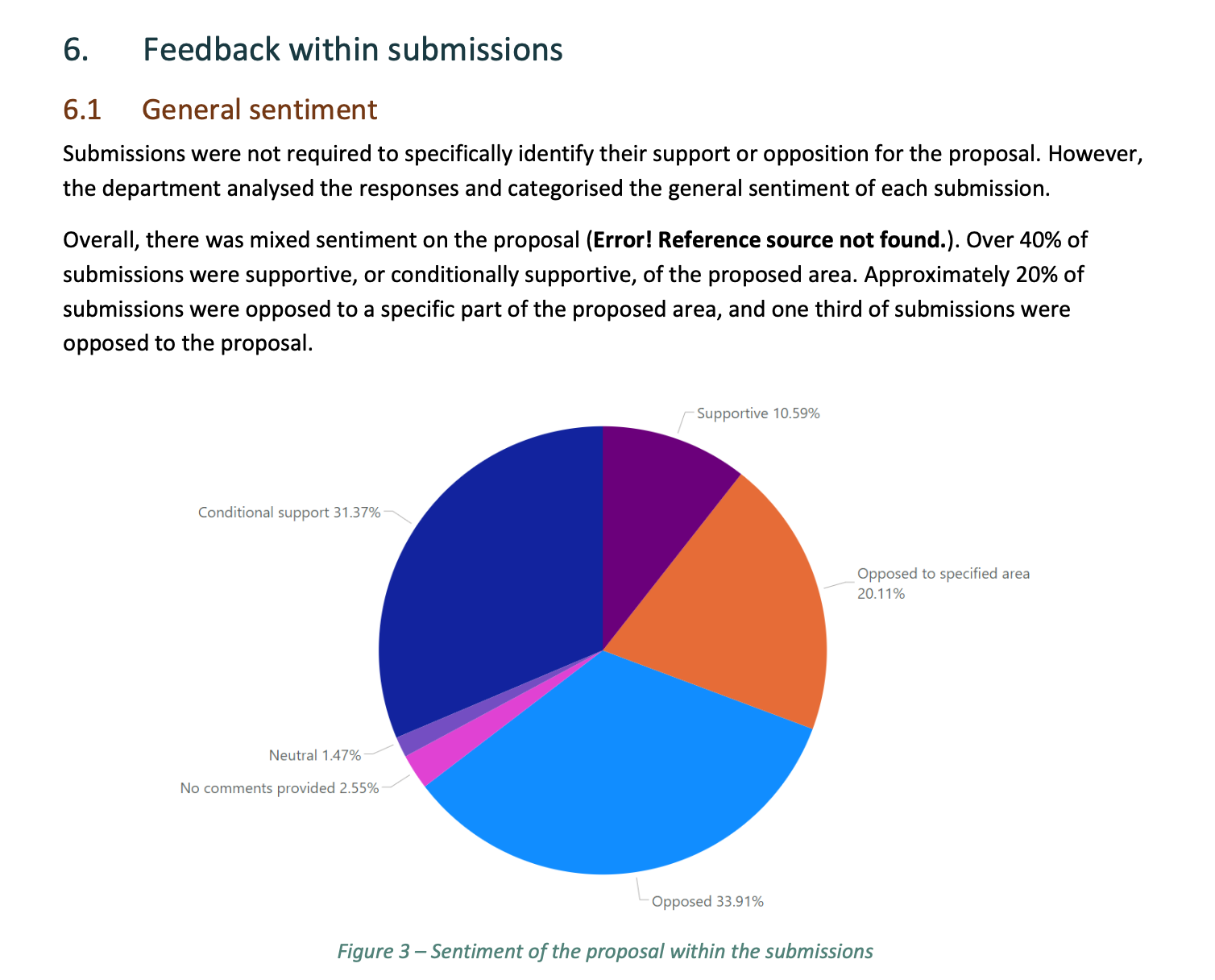
• 𝗣𝘂𝗯𝗹𝗶𝗰 𝗢𝗽𝗽𝗼𝘀𝗶𝘁𝗶𝗼𝗻: Over 50% of submissions opposed the Gippsland offshore wind zone, yet it was approved.
• 𝗣𝗮𝘀𝘁 𝗙𝗮𝗶𝗹𝘂𝗿𝗲𝘀: Due to rushed planning, 21 major Australian projects (e.g., Snowy 2.0, AUKUS, Sydney Light Rail) faced cost blowouts, delays, and mismanagement.
• 𝗗𝗲𝗺𝗮𝗻𝗱𝘀:
1. 𝗜𝗺𝗽𝗹𝗲𝗺𝗲𝗻𝘁 𝗮 𝗺𝗼𝗿𝗮𝘁𝗼𝗿𝗶𝘂𝗺 on ORE approvals until researchers complete studies on ecological, cultural, and economic impacts.
2. 𝗙𝘂𝗻𝗱𝗶𝗻𝗴 for Indigenous-led assessments and cyclone/fisheries studies.
3. 𝗜𝗻𝗱𝗲𝗽𝗲𝗻𝗱𝗲𝗻𝘁 𝗼𝘃𝗲𝗿𝘀𝗶𝗴𝗵𝘁 to ensure compliance with climate goals and biodiversity safeguards.
𝙋𝙧𝙤𝙘𝙚𝙚𝙙𝙞𝙣𝙜 𝙬𝙞𝙩𝙝𝙤𝙪𝙩 𝙚𝙫𝙞𝙙𝙚𝙣𝙘𝙚 𝙧𝙞𝙨𝙠𝙨 𝙞𝙧𝙧𝙚𝙫𝙚𝙧𝙨𝙞𝙗𝙡𝙚 𝙝𝙖𝙧𝙢. 𝘼𝙘𝙩 𝙣𝙤𝙬 𝙩𝙤 𝙥𝙧𝙞𝙤𝙧𝙞𝙩𝙞𝙨𝙚 𝙨𝙘𝙞𝙚𝙣𝙘𝙚 𝙤𝙫𝙚𝙧 𝙝𝙖𝙨𝙩𝙚.
Open Letter
As a concerned citizen deeply invested in Australia's sustainable future, I write to urgently request that your government place a moratorium on Offshore Renewable Energy (ORE) projects until the University of Melbourne's Australian Centre for Offshore Wind Energy (ACOWE) and other major Australian research institutions conduct rigorous, region-specific studies to evaluate the long-term ecological, social, economic, and cultural impacts of these developments. The ACOWE states:
“Offshore wind is facing its own significant challenges, long before the first turbine will generate electricity which, if not addressed, will turn into roadblocks”.
The ACOWE’s extensive list of key research priorities emphasises the need for a moratorium. While offshore wind energy holds promise for decarbonisation, proceeding without Australian-specific evidence risks irreversible harm to nationally protected marine ecosystems under the EPBC Act 1999, coastal communities, First Nations heritage safeguarded by the Native Title Act 1993, and Australia’s economic stability. As the federal government holds ultimate responsibility for inter-jurisdictional environmental approvals and upholding international climate commitments, this issue demands your leadership. I urge you to review Appendix A—Eroding Trust in Government (below), which details 21 Australian projects derailed by the risks now facing offshore wind development. Learning from these failures is not optional—it is imperative.
As the Prime Minister and federal ministers, your government is bound by the duty of care under common law and federal statutory obligations, including the Environment Protection and Biodiversity Conservation Act 1999 (Cth) and the Native Title Act 1993 (Cth). This legal framework imposes a responsibility to avoid reasonably foreseeable harm to coastal communities, marine ecosystems, and First Nations cultural heritage. Should the Federal Government approve or advocate for offshore wind projects without addressing critical gaps in research, consultation, or risk mitigation, it risks exposure to legal scrutiny for:
- Failure to Conduct Adequate Research: Proceeding without region-specific studies on noise pollution, fisheries disruption, or cyclone resilience—despite warnings from the University of Melbourne’s Australian Centre for Offshore Wind Energy (ACOWE)—could constitute a breach of the duty to act on foreseeable risks (Sharma v Minister for the Environment [2021]).
- Disregarding Community Consultation: The Native Title Act 1993 (Cth) and Australia’s commitment to UNDRIP mandate procedural fairness and Free, Prior, and Informed Consent (FPIC). Ignoring concerns from Australian coastal communities, Traditional Owners, and industries may render approvals procedurally invalid, as seen in the precedent of the Sharma v Minister for the Environment [2021]. The federal government is uniquely positioned to coordinate consultation across states and ensure compliance with UNDRIP—a failure to do so risks legal challenges under the Native Title Act 1993 and international law. I also bring to your attention the Offshore Electricity Infrastructure Act 2021 (Cth) and the results of the Department of Climate Change, Energy, the Environment and Water Offshore Renewable Energy Declaration Gippsland, Victoria—Public Consultation Summary Report [2022]. In section 6.1 (and shown below), the sentiment of the proposal within the submissions was 54.02% in opposition, 10.59% supportive, and 31.37% giving conditional support. Why was Gippsland declared an offshore wind energy zone when more than 50% of respondents were in opposition?
- Environmental Harm: Courts increasingly recognise governments’ duty to prevent ecological damage under federal law, as affirmed in Sharma v Minister for the Environment [2021]. Approvals lacking evidence-based safeguards for Bass Strait’s ecosystems—a matter of national environmental significance under the Environment Protection and Biodiversity Conservation Act 1999 (Cth)—could trigger legal claims for failing to uphold the Commonwealth’s duty of care.
1. The Critical Need for Australian-Specific Research
ACOWE itself acknowledges that Australia's offshore wind sector lacks foundational research, stating:
"There is a clear need to coordinate research capabilities in Australia to support the offshore wind sector in a comprehensive manner" (University of Melbourne, 2023).
This admission underscores a glaring gap: Australia cannot rely on Northern Hemisphere data where marine environments, biodiversity, and socio-economic contexts differ vastly. Peer-reviewed studies stress that region-specific research is essential to mitigate risks. Gill (2020) emphasises that 'site-specific assessments are essential as impacts on marine ecosystems vary dramatically between locations due to differences in species composition, oceanographic conditions, and existing environmental stressors.' A 2022 analysis in A 2022 analysis in Marine Policy found that offshore wind projects in Europe caused unanticipated disruptions to seabed ecosystems due to inadequate baseline studies (Hooper et al., 2022), while Soares-Ramos et al. (2020) warn that offshore wind farm expansion risks disrupting traditional fishing activities and altering marine ecosystems critical to commercial fisheries. These findings align with concerns raised by the European Parliament (2022), which cautions that rapid offshore wind deployment without robust environmental safeguards risks irreversible harm to marine biodiversity and coastal livelihoods. In Australia, fisheries contribute $3.1 billion annually to the economy, supporting over 30,000 jobs (ABARES, 2023), and similar impacts could devastate regional industries already grappling with climate change pressures.
2. Environmental Risks to Marine Ecosystems
Australia's oceans host unique ecosystems, including UNESCO-listed sites and migratory pathways for endangered species. Offshore wind infrastructure risks disrupting benthic habitats, generating underwater noise pollution, and altering sediment dynamics. ACOWE identifies "environmental monitoring" as a key research gap, yet authorities grant licenses without addressing these unknowns.
For example, turbine construction in the North Sea led to long-term declines in fish populations (Bergström et al., 2021), while studies in the Persian Gulf emphasise that offshore wind farm expansion risks disrupting traditional fishing activities and altering marine ecosystems critical to commercial fisheries (Majidi Nezhad et al., 2022). In Australia, fisheries contribute $3.1 billion annually to the economy, supporting over 30,000 jobs (ABARES, 2023), and similar impacts could devastate livelihoods.
3. Socio-Economic and Human Impacts on Coastal Communities
Coastal residents face profound uncertainties. Studies of onshore wind farms by Rudolph et al. (2023) found 68% of households reported sleep disturbances due to low-frequency noise, raising concerns about potential impacts from nearshore offshore wind projects. Large-scale offshore renewable energy deployments also risk disrupting local ecosystems and fisheries, which are critical to coastal livelihoods. Recent research highlights that offshore wind infrastructure can alter sediment dynamics, degrade benthic habitats, and displace marine species, with cascading effects on commercial fisheries that contribute $3.1 billion annually to Australia’s economy (Ouro et al., 2024). Such ecological disruptions threaten the financial stability of communities reliant on fishing and marine industries.
Although offshore wind farms will be farther offshore, the concentration of proposed renewable energy projects in nationally significant coastal regions has raised substantial community concerns. Ouro et al. (2024) warn that large-scale deployments risk compounding hydrodynamic changes, such as altered wave patterns and tidal flows, which could destabilise coastal erosion processes and nearshore habitats. These environmental uncertainties align with emerging local trends, including anecdotal reports of residents relocating due to perceived risks to coastal liveability and economic viability.
Tourism, a pillar of coastal economies, is also at risk. While direct studies of offshore wind impacts on Australian tourism are lacking, European research demonstrates that visual changes to seascapes can alter visitor behaviour (Ladenburg et al., 2012). Ouro et al. (2024) further caution that artificial reef effects and noise pollution from offshore infrastructure may deter recreational fishing and diving, sectors vital to Australia’s coastal tourism. Staffell and Pfenninger (2022) warn that "the human dimensions of energy transitions are often overlooked in policy frameworks," a pattern evident in Australia’s rushed approvals.
Rushed approvals without federally coordinated community engagement and adherence to UNDRIP risk replicating the failures documented globally. The Commonwealth’s role in harmonising state and national interests is critical to avoiding costly delays, litigation, and social division. Firestone et al. (2018) found that offshore wind projects lacking transparency and place-based consultation face heightened legal challenges and community opposition—a pattern already emerging in Gippsland’s fishing and tourism sectors.
4. First Nations Cultural Heritage and Rights
First Nations communities have stewarded Australia's oceans for millennia. Offshore developments risk desecrating submerged cultural landscapes and traditional fishing grounds. The United Nations Declaration on the Rights of Indigenous Peoples (UNDRIP) mandates free, prior, and informed consent—unattainable without robust research into cultural impacts. The failure to secure Free, Prior, and Informed Consent (FPIC) in offshore wind development risks replicating the social inequities documented in mining and forestry sectors. Mahanty and McDermott (2013) demonstrate that procedural shortcuts in FPIC exacerbate community distrust, legal challenges, and long-term project failures—a pattern already emerging in regions like Gippsland, where Traditional Owners and fishers report exclusion from consultation processes.
5. Technical and Engineering Challenges
Australia's unique seafloor topography, cyclones, and oceanographic conditions starkly differ from those in the Northern Hemisphere, where developers have designed most existing offshore wind technology. Nguyen et al. (2021) warn that tropical cyclones—intensifying due to climate change—pose catastrophic risks to offshore wind infrastructure designed for milder conditions, necessitating Australia-specific engineering solutions.
6. Economic Prudence and Long-Term Costs
Proceeding without research is fiscally reckless. Retrofitting offshore wind farms to address environmental impacts increases costs by up to 30% (Snyder & Kaiser, 2009). A pause for research now would prevent costly retrofits and stranded assets later.
7. Australian projects with a history of program management, funding, or implementation challenges
Australia’s recent history is marred by large-scale projects plagued by cost blowouts, delays, and systemic mismanagement—failures that offshore renewable energy (ORE) developments risk repeating without rigorous, evidence-based planning. Appendix A lists 21 high-profile initiatives across defence, infrastructure, energy, and healthcare sectors, revealing consistent themes that demand reflection:
- Underestimated Costs and Complexity: Projects like the Snowy 2.0 Hydro Scheme (costs soaring from $2 billion to $12 billion) and Sydney Light Rail (budget doubling to $3.1 billion) demonstrate how optimistic initial forecasts clash with technical realities. With their untested Australian seafloor conditions and cyclone risks, offshore wind farms face similar peril without robust feasibility studies.
- Geopolitical and Diplomatic Risks: The AUKUS submarine program ($268-$368 billion of 30 years) and failed French submarine deal ($90 billion cancellation) highlight how abrupt policy shifts and reliance on foreign technology strain international relations and budgets. ORE projects dependent on overseas expertise risk analogous pitfalls.
- Contractor-Government Conflicts: The Westgate Tunnel ($10 billion, delayed to 2027-2028) and a Perth Children’s Hospital ($2 billion asbestos contamination) collapsed due to flawed risk assessments and contractor disputes. Offshore wind’s scale necessitates airtight contracts and transparent risk allocation—lessons yet to be applied.
- Political Interference and Short-Termism: The National Broadband Network ($51 billion, outdated copper reliance) and East West Link ($1.1 billion cancellation) were derailed by politicised decisions. ORE licensing must rise above electoral cycles to ensure technical—not ideological—rigour.
These failures share a common root: a lack of transparent planning, independent oversight, and adaptive governance. Offshore wind energy cannot afford to inherit these flaws. As detailed in Appendix A, Australia’s project history is a cautionary tale that demands your government pause ORE approvals until ACOWEs and other major Australian research establish safeguards against repeating these errors.
8. Request for Action
Australia’s climate ambitions, including its obligations under the Paris Agreement and COP28 pledges, must not sacrifice scientific due diligence. The federal government’s authority over national energy policy and cross-jurisdictional projects requires it to set a precedent for evidence-based decision-making. I urge your government to:
- Implement an immediate moratorium on federal approvals for all new Offshore Renewable Energy (ORE) projects under the Environment Protection and Biodiversity Conservation Act 1999 (Cth) until the Australian Centre for Offshore Wind Energy (ACOWE), in collaboration with CSIRO and First Nations representatives, completes comprehensive, region-specific studies evaluating long-term ecological, cultural, and socio-economic risks. This pause must align with the precautionary principle enshrined in the EPBC Act to avoid irreversible harm to matters of national environmental significance, including marine biodiversity and Indigenous cultural heritage.
- Allocate dedicated federal funding through the National Energy Transformation Partnership or the 2024–25 Budget to accelerate Australia-wide interdisciplinary research. This must include:
- Indigenous-led impact assessments conducted under the Native Title Act 1993 (Cth) and the United Nations Declaration on the Rights of Indigenous Peoples (UNDRIP), ensuring Free, Prior, and Informed Consent (FPIC) from Traditional Owners.
- Collaborative studies with state governments, universities, and industries to address gaps in cyclone resilience, fisheries disruption, and cumulative impacts on UNESCO World Heritage marine sites (e.g., the Great Barrier Reef).
- Establish a federally appointed Independent Scientific Advisory Panel (ISAP) under the Department of Climate Change, Energy, the Environment, and Water. The ISAP’s mandate must include:
- Reviewing all existing ORE licenses for compliance with updated research and international best practices (e.g., EU Marine Strategy Framework Directive).
- Publishing transparent risk assessments to guide project modifications, cancellations, or retrofits.
- Ensuring alignment with Australia’s obligations under the Paris Agreement and the Global Biodiversity Framework.
This open letter is not in opposition to renewable energy but a plea for responsible, evidence-based development.
Proceeding without evidence is not innovation—it is recklessness.
Conclusion
Prime Minister and Ministers, we stand at a crossroads. We can repeat the mistakes of nations and our history of prioritising speed over science or lead the world in equitable, sustainable decarbonisation. Halting ORE projects until research is completed honours the precautionary principle enshrined in Australia's Environment Protection and Biodiversity Conservation Act 1999 and safeguards our environment, communities, and future. I urge you to review Appendix A—Eroding Trust in Government, which details 21 Australian projects derailed by the risks now facing offshore wind development. Learning from these failures is not optional—it is imperative.
Respectfully, I await your urgent action.
Sincerely,
James-Anthony Giorlando
Concerned Australian Citizen
Paradise Beach VIC 3851
Appendix A—Eroding trust in Government
Note: While many of the projects below are state-based, they reflect systemic governance challenges—cost blowouts, consultation failures, and politicisation—that demand federal vigilance in offshore renewable energy approvals.
- Failed Nuclear Submarine Deal with France (2021)
- Sector: Defence
- Issues:
- Australia cancelled a 90 billion dollar contract with France’s Naval Group in 2021 for 12 diesel-powered submarines, opting instead for nuclear-powered submarines under the AUKUS pact.
- The abrupt termination triggered a diplomatic crisis with France, which accused Australia of betrayal. Australia compensated Naval Group with 835 million dollars.
- Key Problems:
- Lack of transparency in decision-making and failure to consult France.
- Strategic misalignment: The diesel submarines were deemed obsolete as Australia shifted focus to counter China in the Indo-Pacific.
- AUKUS Nuclear Submarine Program (Ongoing)
- Sector: Defence
- Issues:
- Delays: The first Australian-built nuclear submarine is now unlikely to arrive before 2040, a decade later than initially suggested.
- Cost Blowouts: Estimates for the program range from 268 billion to 368 billion dollars over 30 years, making it Australia’s most expensive defence project ever. Critics argue costs could escalate further.
- Implementation Risks:
- Australia lacks a domestic nuclear industry or workforce to build/reactor-maintain submarines.
- Reliance on US/UK technology transfers, which face bureaucratic and political hurdles.
- Concerns about port infrastructure and nuclear waste management.
- Key Problems:
- Ambiguity in timelines, funding, and technical feasibility.
- Geopolitical tensions: The program risks inflaming relations with China and regional neighbours.
- Sydney Light Rail (New South Wales)
- Sector: Transport
- Issues: Budget overruns from 1.6 billion dollars to 3.1 billion dollars, with delays of 18 months. Legal disputes between the government and contractors, plus business disruptions along the route.
- Key Problems: Poor stakeholder communication highlights the need for federal coordination to avoid fragmented planning in nationally significant infrastructure.
- WestConnex Motorway (New South Wales)
- Sector: Road
- Issues: Costs rose from 10 billion dollars to 16.8 billion dollars, and there was community backlash over tolls and property acquisitions.
- Key Problems: Inadequate consultation and traffic modelling.
- National Broadband Network (NBN) (National)
- Sector: Telecommunications
- Issues: Budgets ballooned from 29.5 billion dollars to over 51 billion dollars, with delays and reliance on outdated copper networks.
- Key Problems: Politicisation of technical decisions.
- Adelaide Desalination Plant (South Australia)
- Sector: Water
- Issues: Costs doubled to 2.2 billion dollars, with the plant operating at 10% capacity due to low demand.
- Key Problems: Overestimated drought risks and inflexible contracts.
- East West Link (Victoria)
- Sector: Road
- Issues: Cancelled after 1.1 billion dollars was spent, with no construction.
- Key Problems: Politically motivated cancellations underscore federal oversight's importance in insulating critical projects from electoral cycles.
- Inland Rail (National)
- Sector: Rail
- Issues: Costs surged from 4.4 billion dollars to 20 billion dollars, with route disputes and flooding risks.
- Key Problems: Mismanagement by the Australian Rail Track Corporation.
- Perth Children’s Hospital (Western Australia)
- Sector: Healthcare
- Issues: Opened four years late at 2 billion dollars, with asbestos and water contamination.
- Key Problems: Contractor failures and safety oversights.
- Snowy 2.0 Hydro Project (New South Wales)
- Sector: Energy
- Issues: Costs rose from 2 billion dollars to 12 billion dollars, with delays and environmental concerns.
- Key Problems: Underestimated tunnelling challenges in the Alps.
- Barangaroo Crown Casino (New South Wales)
- Sector: Mixed-Use Development
- Issues: Loss of gaming license in 2021 due to governance failures.
- Key Problems: Regulatory breaches and design changes.
- Victoria’s 2026 Commonwealth Games
- Sector: Event Infrastructure
- Issues: Cancelled in 2023 after projected costs tripled to 7 billion dollars.
- Key Problems: Unrealistic regional venue plans.
- Murray Basin Rail Project (Victoria)
- Sector: Rail
- Issues: Costs doubled to 1 billion dollars, leaving upgrades incomplete.
- Key Problems: Poor federal-state coordination.
- Hobart Airport Roundabout (Tasmania)
- Sector: Road
- Issues: Costs rose from 46 million dollars to 75 million dollars due to design flaws.
- Key Problems: Inadequate geotechnical surveys.
- Sydney Ferries "Freshwater-class" (New South Wales)
- Sector: Transport
- Issues: 30 million dollars spent retrofitting wharves for oversized ferries.
- Key Problems: Poor design alignment.
- Westgate Tunnel Project (Victoria)
- Sector: Road
- Issues: Costs doubled to 10 billion dollars, with delays until 2027–2028 due to contaminated soil.
- Key Problems: Flawed risk assessments.
- Melbourne Metro Tunnel (Victoria)
- Sector: Rail
- Issues: Budgets increased to 12.6 billion dollars, with tunnelling challenges under the Yarra River.
- Key Problems: Labor disputes and engineering complexity.
- Cross River Rail (Queensland)
- Sector: Rail
- Issues: Costs rose to 6.3 billion dollars amid contractor disputes.
- Key Problems: Coordination delays.
- Sydney Metro City & Southwest Line (New South Wales)
- Sector: Rail
- Issues: Budgets surged to 18.5 billion dollars, with heritage site conflicts.
- Key Problems: Community consultation failures.
- Marinus Link (Tasmania)
- Sector: Energy
- Issues: Costs doubled to 7 billion dollars, with debates over viability.
- Key Problems: Interstate funding disputes.
- West Gate Bridge Strengthening Project (Victoria)
- Sector: Road
- Issues: Costs rose to 500 million dollars due to design flaws.
- Key Problems: Rushed engineering reviews.
Key Themes Across All Projects
- Underestimated Costs: Optimistic initial budgets revised due to technical, political, or environmental surprises.
- Geopolitical Risks: Submarine deals highlight how international partnerships can backfire without clear planning.
- Contractor-Government Conflict: Legal battles over risk allocation (e.g., Westgate Tunnel’s soil crisis).
- Political Interference: Sudden policy shifts (e.g., NBN, AUKUS) disrupt long-term projects.
References
ABC News. (2022, August 10). Trawl fishers to seek wind farm zone compensation if excluded from areas off Victoria, Tasmania. https://www.abc.net.au/news/2022-08-10/trawl-fishers-to-seek-wind-farm-zone-compensation-if-excluded/101318000
Australian Bureau of Agricultural and Resource Economics and Sciences. (2022). Australian fisheries and aquaculture statistics 2022. Australian Government. https://www.agriculture.gov.au/abares/research-topics/fisheries/fisheries-and-aquaculture-statistics
Australian Centre for Offshore Wind Energy. (2023). Purpose and vision. University of Melbourne. https://eng.unimelb.edu.au/acowe
Department of Climate Change, Energy, the Environment and Water. (2023). Offshore renewable energy infrastructure area proposal: Bass Strait off Gippsland: Consultation summary report. Australian Government. https://consult.dcceew.gov.au/oei-gippsland
Eichholtz, P., Kok, N., Langen, M., & van Vulpen, D. (2023). Clean electricity, dirty electricity: The effect on local house prices. Journal of Real Estate Finance & Economics, 66, 743–777. https://doi.org/10.1007/s11146-021-09878-6
European Parliament. (2022). A European strategy for offshore renewable energy (Resolution 2021/2012(INI)). https://www.europarl.europa.eu/doceo/document/TA-9-2022-0034_EN.html
Firestone, J., Hoen, B., Rand, J., Elliott, D., Hübner, G., & Pohl, J. (2017). Reconsidering barriers to wind power projects: community engagement, developer transparency and place. Journal of Environmental Policy & Planning, 20(3), 370–386. https://doi.org/10.1080/1523908X.2017.1418656
Gill, A. B. (2020). Offshore renewable energy: Ecological implications of generating electricity in the coastal zone. Journal of Applied Ecology, 57(6), 1345–1355. https://doi.org/10.1111/j.1365-2664.2005.01060.x
Ladenburg, J., Möller, B., & Tranberg, J. (2013). Visual impact assessment of offshore wind farms and prior experience. Energy Policy, 62, 779–785. https://doi.org/10.1016/j.apenergy.2008.05.005
Mahanty, S., & McDermott, C. L. (2013). How does 'Free, Prior and Informed Consent' (FPIC) impact social equity? Lessons from mining and forestry and their implications for REDD+. Land Use Policy, 35, 406-416. https://doi.org/10.1016/j.landusepol.2013.06.014
Majidi Nezhad, M., Neshat, M., Piras, G., & Astiaso Garcia, D. (2022). Sites exploring prioritisation of offshore wind energy potential and mapping for wind farms installation: Iranian islands case studies. Renewable and Sustainable Energy Reviews, 167, 111696. https://doi.org/10.1016/j.rser.2022.112791
Ouro, P., Fernandez, R., Armstrong, A., Brooks, B., Burton, R. R., Folkard, A., ... & Watson, F. M. (2024). Environmental impacts from large-scale offshore renewable-energy deployment. Environmental Research Letters, 19(6), 063001. https://doi.org/10.1088/1748-9326/addc7d
Sharma v Minister for the Environment [2021] FCA 560. (2021, May 27). Federal Court of Australia. https://www.fedcourt.gov.au/services/access-to-files-and-transcripts/online-files/minister-for-the-environment-v-sharma
Snyder, B., & Kaiser, M. J. (2009). Ecological and economic cost-benefit analysis of offshore wind energy. Renewable Energy, 34(6), 1567–1578. https://doi.org/10.1016/j.renene.2008.11.015
Soares-Ramos, E. P. P., de Oliveira-Assis, L., Sarrias-Mena, R., & Fernández-Ramírez, L. M. (2020). Current status and future trends of offshore wind power in Europe. Energy, 213, 117787. https://doi.org/10.1016/j.energy.2020.117787
University of Melbourne, Australian Centre for Offshore Wind Energy. (n.d.). Research and training. https://eng.unimelb.edu.au/acowe/research-and-training

JOIN Voices for Gippsland
JOIN TODAY at https://voicesforgippsland.com
Mission:
Our goal is to empower the Gippsland community through participatory democracy and grassroots advocacy, ensuring that every voice influences the decisions that affect our region. We advocate for ethical leadership, amplify local priorities in governance, and foster collaboration to achieve equitable, sustainable, and culturally respectful outcomes.
Vision:
A Gippsland where all communities promote inclusive governance, ensuring that policies reflect grassroots priorities. A region where transparency and ethical leadership are essential, environmental stewardship is rooted in culture, and all voices contribute to a thriving, equitable future.
Values:
Inclusivity—We are dedicated to creating a Gippsland where everyone feels valued and respected and has equal opportunities, regardless of their background or identity. This commitment is essential for our diverse region, ensuring our policies benefit all residents, including First Nations communities and marginalised groups, fostering a sense of belonging and participation.
Sustainability—We are committed to protecting Gippsland's environment and resources, creating a future that fulfils present needs without compromising future generations. This is vital for preserving natural beauty, supporting industries, and addressing climate change through responsible practices.
Community Empowerment—We believe in empowering Gippsland's communities to have a strong voice in decision-making, fostering local leadership, and supporting initiatives that enhance community capacity and resilience. Empowering Gippsland means supporting local organisations and ensuring that residents shape their own future.
Ethical Leadership—We are dedicated to leading with integrity and making responsible decisions that prioritise the best interests of Gippsland and its people. This commitment encompasses transparency, accountability, and adherence to high ethical standards in all our actions.
Progressive Change—We focus on driving positive social, economic, and environmental change through forward-thinking policies and innovative solutions. Embracing progressive change enables us to adapt to evolving challenges and create a more prosperous, equitable, and sustainable future for Gippsland.
Responsible Innovation—We are committed to exploring new ideas and technologies that benefit Gippsland. We prioritise research, community engagement, and reducing negative impacts on our environment and communities. This approach guarantees that innovation is sustainable and honours Gippsland's unique character.
JOIN TODAY at https://voicesforgippsland.com

1,350
The issue
Open Letter to the Prime Minister and Department of Climate Change, Energy, the Environment and Water
Urgent Call for a Moratorium on Offshore Renewable Energy Projects Until Comprehensive Research is Completed
To the Honourable Anthony Albanese MP, Prime Minister; Chris Bowen MP, Minister for Climate Change and Energy; Tanya Plibersek MP, Minister for the Environment and Water; and Josh Wilson MP, Assistant Minister for Climate Change and Energy.
Summary of Open Letter (tl;dr)
This open letter urgently urges the Australian government to 𝗵𝗮𝗹𝘁 𝗮𝗹𝗹 𝗢𝗳𝗳𝘀𝗵𝗼𝗿𝗲 𝗥𝗲𝗻𝗲𝘄𝗮𝗯𝗹𝗲 𝗘𝗻𝗲𝗿𝗴𝘆 (𝗢𝗥𝗘) 𝗽𝗿𝗼𝗷𝗲𝗰𝘁𝘀 until they complete comprehensive, region-specific research. Key points:
• 𝗘𝗻𝘃𝗶𝗿𝗼𝗻𝗺𝗲𝗻𝘁𝗮𝗹 𝗥𝗶𝘀𝗸𝘀: Offshore wind projects threaten protected marine ecosystems, fisheries ($3.1B industry), and UNESCO sites. Northern Hemisphere data is insufficient for Australia’s unique conditions.
• 𝗟𝗲𝗴𝗮𝗹 𝗢𝗯𝗹𝗶𝗴𝗮𝘁𝗶𝗼𝗻𝘀: Approvals risk violating the EPBC Act 1999 and Native Title Act 1993 by failing to address foreseeable harm to ecosystems, coastal communities, and First Nations heritage.
• 𝗣𝘂𝗯𝗹𝗶𝗰 𝗢𝗽𝗽𝗼𝘀𝗶𝘁𝗶𝗼𝗻: Over 50% of submissions opposed the Gippsland offshore wind zone, yet it was approved.
• 𝗣𝗮𝘀𝘁 𝗙𝗮𝗶𝗹𝘂𝗿𝗲𝘀: Due to rushed planning, 21 major Australian projects (e.g., Snowy 2.0, AUKUS, Sydney Light Rail) faced cost blowouts, delays, and mismanagement.
• 𝗗𝗲𝗺𝗮𝗻𝗱𝘀:
1. 𝗜𝗺𝗽𝗹𝗲𝗺𝗲𝗻𝘁 𝗮 𝗺𝗼𝗿𝗮𝘁𝗼𝗿𝗶𝘂𝗺 on ORE approvals until researchers complete studies on ecological, cultural, and economic impacts.
2. 𝗙𝘂𝗻𝗱𝗶𝗻𝗴 for Indigenous-led assessments and cyclone/fisheries studies.
3. 𝗜𝗻𝗱𝗲𝗽𝗲𝗻𝗱𝗲𝗻𝘁 𝗼𝘃𝗲𝗿𝘀𝗶𝗴𝗵𝘁 to ensure compliance with climate goals and biodiversity safeguards.
𝙋𝙧𝙤𝙘𝙚𝙚𝙙𝙞𝙣𝙜 𝙬𝙞𝙩𝙝𝙤𝙪𝙩 𝙚𝙫𝙞𝙙𝙚𝙣𝙘𝙚 𝙧𝙞𝙨𝙠𝙨 𝙞𝙧𝙧𝙚𝙫𝙚𝙧𝙨𝙞𝙗𝙡𝙚 𝙝𝙖𝙧𝙢. 𝘼𝙘𝙩 𝙣𝙤𝙬 𝙩𝙤 𝙥𝙧𝙞𝙤𝙧𝙞𝙩𝙞𝙨𝙚 𝙨𝙘𝙞𝙚𝙣𝙘𝙚 𝙤𝙫𝙚𝙧 𝙝𝙖𝙨𝙩𝙚.
Open Letter
As a concerned citizen deeply invested in Australia's sustainable future, I write to urgently request that your government place a moratorium on Offshore Renewable Energy (ORE) projects until the University of Melbourne's Australian Centre for Offshore Wind Energy (ACOWE) and other major Australian research institutions conduct rigorous, region-specific studies to evaluate the long-term ecological, social, economic, and cultural impacts of these developments. The ACOWE states:
“Offshore wind is facing its own significant challenges, long before the first turbine will generate electricity which, if not addressed, will turn into roadblocks”.
The ACOWE’s extensive list of key research priorities emphasises the need for a moratorium. While offshore wind energy holds promise for decarbonisation, proceeding without Australian-specific evidence risks irreversible harm to nationally protected marine ecosystems under the EPBC Act 1999, coastal communities, First Nations heritage safeguarded by the Native Title Act 1993, and Australia’s economic stability. As the federal government holds ultimate responsibility for inter-jurisdictional environmental approvals and upholding international climate commitments, this issue demands your leadership. I urge you to review Appendix A—Eroding Trust in Government (below), which details 21 Australian projects derailed by the risks now facing offshore wind development. Learning from these failures is not optional—it is imperative.
As the Prime Minister and federal ministers, your government is bound by the duty of care under common law and federal statutory obligations, including the Environment Protection and Biodiversity Conservation Act 1999 (Cth) and the Native Title Act 1993 (Cth). This legal framework imposes a responsibility to avoid reasonably foreseeable harm to coastal communities, marine ecosystems, and First Nations cultural heritage. Should the Federal Government approve or advocate for offshore wind projects without addressing critical gaps in research, consultation, or risk mitigation, it risks exposure to legal scrutiny for:
- Failure to Conduct Adequate Research: Proceeding without region-specific studies on noise pollution, fisheries disruption, or cyclone resilience—despite warnings from the University of Melbourne’s Australian Centre for Offshore Wind Energy (ACOWE)—could constitute a breach of the duty to act on foreseeable risks (Sharma v Minister for the Environment [2021]).
- Disregarding Community Consultation: The Native Title Act 1993 (Cth) and Australia’s commitment to UNDRIP mandate procedural fairness and Free, Prior, and Informed Consent (FPIC). Ignoring concerns from Australian coastal communities, Traditional Owners, and industries may render approvals procedurally invalid, as seen in the precedent of the Sharma v Minister for the Environment [2021]. The federal government is uniquely positioned to coordinate consultation across states and ensure compliance with UNDRIP—a failure to do so risks legal challenges under the Native Title Act 1993 and international law. I also bring to your attention the Offshore Electricity Infrastructure Act 2021 (Cth) and the results of the Department of Climate Change, Energy, the Environment and Water Offshore Renewable Energy Declaration Gippsland, Victoria—Public Consultation Summary Report [2022]. In section 6.1 (and shown below), the sentiment of the proposal within the submissions was 54.02% in opposition, 10.59% supportive, and 31.37% giving conditional support. Why was Gippsland declared an offshore wind energy zone when more than 50% of respondents were in opposition?
- Environmental Harm: Courts increasingly recognise governments’ duty to prevent ecological damage under federal law, as affirmed in Sharma v Minister for the Environment [2021]. Approvals lacking evidence-based safeguards for Bass Strait’s ecosystems—a matter of national environmental significance under the Environment Protection and Biodiversity Conservation Act 1999 (Cth)—could trigger legal claims for failing to uphold the Commonwealth’s duty of care.
1. The Critical Need for Australian-Specific Research
ACOWE itself acknowledges that Australia's offshore wind sector lacks foundational research, stating:
"There is a clear need to coordinate research capabilities in Australia to support the offshore wind sector in a comprehensive manner" (University of Melbourne, 2023).
This admission underscores a glaring gap: Australia cannot rely on Northern Hemisphere data where marine environments, biodiversity, and socio-economic contexts differ vastly. Peer-reviewed studies stress that region-specific research is essential to mitigate risks. Gill (2020) emphasises that 'site-specific assessments are essential as impacts on marine ecosystems vary dramatically between locations due to differences in species composition, oceanographic conditions, and existing environmental stressors.' A 2022 analysis in A 2022 analysis in Marine Policy found that offshore wind projects in Europe caused unanticipated disruptions to seabed ecosystems due to inadequate baseline studies (Hooper et al., 2022), while Soares-Ramos et al. (2020) warn that offshore wind farm expansion risks disrupting traditional fishing activities and altering marine ecosystems critical to commercial fisheries. These findings align with concerns raised by the European Parliament (2022), which cautions that rapid offshore wind deployment without robust environmental safeguards risks irreversible harm to marine biodiversity and coastal livelihoods. In Australia, fisheries contribute $3.1 billion annually to the economy, supporting over 30,000 jobs (ABARES, 2023), and similar impacts could devastate regional industries already grappling with climate change pressures.
2. Environmental Risks to Marine Ecosystems
Australia's oceans host unique ecosystems, including UNESCO-listed sites and migratory pathways for endangered species. Offshore wind infrastructure risks disrupting benthic habitats, generating underwater noise pollution, and altering sediment dynamics. ACOWE identifies "environmental monitoring" as a key research gap, yet authorities grant licenses without addressing these unknowns.
For example, turbine construction in the North Sea led to long-term declines in fish populations (Bergström et al., 2021), while studies in the Persian Gulf emphasise that offshore wind farm expansion risks disrupting traditional fishing activities and altering marine ecosystems critical to commercial fisheries (Majidi Nezhad et al., 2022). In Australia, fisheries contribute $3.1 billion annually to the economy, supporting over 30,000 jobs (ABARES, 2023), and similar impacts could devastate livelihoods.
3. Socio-Economic and Human Impacts on Coastal Communities
Coastal residents face profound uncertainties. Studies of onshore wind farms by Rudolph et al. (2023) found 68% of households reported sleep disturbances due to low-frequency noise, raising concerns about potential impacts from nearshore offshore wind projects. Large-scale offshore renewable energy deployments also risk disrupting local ecosystems and fisheries, which are critical to coastal livelihoods. Recent research highlights that offshore wind infrastructure can alter sediment dynamics, degrade benthic habitats, and displace marine species, with cascading effects on commercial fisheries that contribute $3.1 billion annually to Australia’s economy (Ouro et al., 2024). Such ecological disruptions threaten the financial stability of communities reliant on fishing and marine industries.
Although offshore wind farms will be farther offshore, the concentration of proposed renewable energy projects in nationally significant coastal regions has raised substantial community concerns. Ouro et al. (2024) warn that large-scale deployments risk compounding hydrodynamic changes, such as altered wave patterns and tidal flows, which could destabilise coastal erosion processes and nearshore habitats. These environmental uncertainties align with emerging local trends, including anecdotal reports of residents relocating due to perceived risks to coastal liveability and economic viability.
Tourism, a pillar of coastal economies, is also at risk. While direct studies of offshore wind impacts on Australian tourism are lacking, European research demonstrates that visual changes to seascapes can alter visitor behaviour (Ladenburg et al., 2012). Ouro et al. (2024) further caution that artificial reef effects and noise pollution from offshore infrastructure may deter recreational fishing and diving, sectors vital to Australia’s coastal tourism. Staffell and Pfenninger (2022) warn that "the human dimensions of energy transitions are often overlooked in policy frameworks," a pattern evident in Australia’s rushed approvals.
Rushed approvals without federally coordinated community engagement and adherence to UNDRIP risk replicating the failures documented globally. The Commonwealth’s role in harmonising state and national interests is critical to avoiding costly delays, litigation, and social division. Firestone et al. (2018) found that offshore wind projects lacking transparency and place-based consultation face heightened legal challenges and community opposition—a pattern already emerging in Gippsland’s fishing and tourism sectors.
4. First Nations Cultural Heritage and Rights
First Nations communities have stewarded Australia's oceans for millennia. Offshore developments risk desecrating submerged cultural landscapes and traditional fishing grounds. The United Nations Declaration on the Rights of Indigenous Peoples (UNDRIP) mandates free, prior, and informed consent—unattainable without robust research into cultural impacts. The failure to secure Free, Prior, and Informed Consent (FPIC) in offshore wind development risks replicating the social inequities documented in mining and forestry sectors. Mahanty and McDermott (2013) demonstrate that procedural shortcuts in FPIC exacerbate community distrust, legal challenges, and long-term project failures—a pattern already emerging in regions like Gippsland, where Traditional Owners and fishers report exclusion from consultation processes.
5. Technical and Engineering Challenges
Australia's unique seafloor topography, cyclones, and oceanographic conditions starkly differ from those in the Northern Hemisphere, where developers have designed most existing offshore wind technology. Nguyen et al. (2021) warn that tropical cyclones—intensifying due to climate change—pose catastrophic risks to offshore wind infrastructure designed for milder conditions, necessitating Australia-specific engineering solutions.
6. Economic Prudence and Long-Term Costs
Proceeding without research is fiscally reckless. Retrofitting offshore wind farms to address environmental impacts increases costs by up to 30% (Snyder & Kaiser, 2009). A pause for research now would prevent costly retrofits and stranded assets later.
7. Australian projects with a history of program management, funding, or implementation challenges
Australia’s recent history is marred by large-scale projects plagued by cost blowouts, delays, and systemic mismanagement—failures that offshore renewable energy (ORE) developments risk repeating without rigorous, evidence-based planning. Appendix A lists 21 high-profile initiatives across defence, infrastructure, energy, and healthcare sectors, revealing consistent themes that demand reflection:
- Underestimated Costs and Complexity: Projects like the Snowy 2.0 Hydro Scheme (costs soaring from $2 billion to $12 billion) and Sydney Light Rail (budget doubling to $3.1 billion) demonstrate how optimistic initial forecasts clash with technical realities. With their untested Australian seafloor conditions and cyclone risks, offshore wind farms face similar peril without robust feasibility studies.
- Geopolitical and Diplomatic Risks: The AUKUS submarine program ($268-$368 billion of 30 years) and failed French submarine deal ($90 billion cancellation) highlight how abrupt policy shifts and reliance on foreign technology strain international relations and budgets. ORE projects dependent on overseas expertise risk analogous pitfalls.
- Contractor-Government Conflicts: The Westgate Tunnel ($10 billion, delayed to 2027-2028) and a Perth Children’s Hospital ($2 billion asbestos contamination) collapsed due to flawed risk assessments and contractor disputes. Offshore wind’s scale necessitates airtight contracts and transparent risk allocation—lessons yet to be applied.
- Political Interference and Short-Termism: The National Broadband Network ($51 billion, outdated copper reliance) and East West Link ($1.1 billion cancellation) were derailed by politicised decisions. ORE licensing must rise above electoral cycles to ensure technical—not ideological—rigour.
These failures share a common root: a lack of transparent planning, independent oversight, and adaptive governance. Offshore wind energy cannot afford to inherit these flaws. As detailed in Appendix A, Australia’s project history is a cautionary tale that demands your government pause ORE approvals until ACOWEs and other major Australian research establish safeguards against repeating these errors.
8. Request for Action
Australia’s climate ambitions, including its obligations under the Paris Agreement and COP28 pledges, must not sacrifice scientific due diligence. The federal government’s authority over national energy policy and cross-jurisdictional projects requires it to set a precedent for evidence-based decision-making. I urge your government to:
- Implement an immediate moratorium on federal approvals for all new Offshore Renewable Energy (ORE) projects under the Environment Protection and Biodiversity Conservation Act 1999 (Cth) until the Australian Centre for Offshore Wind Energy (ACOWE), in collaboration with CSIRO and First Nations representatives, completes comprehensive, region-specific studies evaluating long-term ecological, cultural, and socio-economic risks. This pause must align with the precautionary principle enshrined in the EPBC Act to avoid irreversible harm to matters of national environmental significance, including marine biodiversity and Indigenous cultural heritage.
- Allocate dedicated federal funding through the National Energy Transformation Partnership or the 2024–25 Budget to accelerate Australia-wide interdisciplinary research. This must include:
- Indigenous-led impact assessments conducted under the Native Title Act 1993 (Cth) and the United Nations Declaration on the Rights of Indigenous Peoples (UNDRIP), ensuring Free, Prior, and Informed Consent (FPIC) from Traditional Owners.
- Collaborative studies with state governments, universities, and industries to address gaps in cyclone resilience, fisheries disruption, and cumulative impacts on UNESCO World Heritage marine sites (e.g., the Great Barrier Reef).
- Establish a federally appointed Independent Scientific Advisory Panel (ISAP) under the Department of Climate Change, Energy, the Environment, and Water. The ISAP’s mandate must include:
- Reviewing all existing ORE licenses for compliance with updated research and international best practices (e.g., EU Marine Strategy Framework Directive).
- Publishing transparent risk assessments to guide project modifications, cancellations, or retrofits.
- Ensuring alignment with Australia’s obligations under the Paris Agreement and the Global Biodiversity Framework.
This open letter is not in opposition to renewable energy but a plea for responsible, evidence-based development.
Proceeding without evidence is not innovation—it is recklessness.
Conclusion
Prime Minister and Ministers, we stand at a crossroads. We can repeat the mistakes of nations and our history of prioritising speed over science or lead the world in equitable, sustainable decarbonisation. Halting ORE projects until research is completed honours the precautionary principle enshrined in Australia's Environment Protection and Biodiversity Conservation Act 1999 and safeguards our environment, communities, and future. I urge you to review Appendix A—Eroding Trust in Government, which details 21 Australian projects derailed by the risks now facing offshore wind development. Learning from these failures is not optional—it is imperative.
Respectfully, I await your urgent action.
Sincerely,
James-Anthony Giorlando
Concerned Australian Citizen
Paradise Beach VIC 3851
Appendix A—Eroding trust in Government
Note: While many of the projects below are state-based, they reflect systemic governance challenges—cost blowouts, consultation failures, and politicisation—that demand federal vigilance in offshore renewable energy approvals.
- Failed Nuclear Submarine Deal with France (2021)
- Sector: Defence
- Issues:
- Australia cancelled a 90 billion dollar contract with France’s Naval Group in 2021 for 12 diesel-powered submarines, opting instead for nuclear-powered submarines under the AUKUS pact.
- The abrupt termination triggered a diplomatic crisis with France, which accused Australia of betrayal. Australia compensated Naval Group with 835 million dollars.
- Key Problems:
- Lack of transparency in decision-making and failure to consult France.
- Strategic misalignment: The diesel submarines were deemed obsolete as Australia shifted focus to counter China in the Indo-Pacific.
- AUKUS Nuclear Submarine Program (Ongoing)
- Sector: Defence
- Issues:
- Delays: The first Australian-built nuclear submarine is now unlikely to arrive before 2040, a decade later than initially suggested.
- Cost Blowouts: Estimates for the program range from 268 billion to 368 billion dollars over 30 years, making it Australia’s most expensive defence project ever. Critics argue costs could escalate further.
- Implementation Risks:
- Australia lacks a domestic nuclear industry or workforce to build/reactor-maintain submarines.
- Reliance on US/UK technology transfers, which face bureaucratic and political hurdles.
- Concerns about port infrastructure and nuclear waste management.
- Key Problems:
- Ambiguity in timelines, funding, and technical feasibility.
- Geopolitical tensions: The program risks inflaming relations with China and regional neighbours.
- Sydney Light Rail (New South Wales)
- Sector: Transport
- Issues: Budget overruns from 1.6 billion dollars to 3.1 billion dollars, with delays of 18 months. Legal disputes between the government and contractors, plus business disruptions along the route.
- Key Problems: Poor stakeholder communication highlights the need for federal coordination to avoid fragmented planning in nationally significant infrastructure.
- WestConnex Motorway (New South Wales)
- Sector: Road
- Issues: Costs rose from 10 billion dollars to 16.8 billion dollars, and there was community backlash over tolls and property acquisitions.
- Key Problems: Inadequate consultation and traffic modelling.
- National Broadband Network (NBN) (National)
- Sector: Telecommunications
- Issues: Budgets ballooned from 29.5 billion dollars to over 51 billion dollars, with delays and reliance on outdated copper networks.
- Key Problems: Politicisation of technical decisions.
- Adelaide Desalination Plant (South Australia)
- Sector: Water
- Issues: Costs doubled to 2.2 billion dollars, with the plant operating at 10% capacity due to low demand.
- Key Problems: Overestimated drought risks and inflexible contracts.
- East West Link (Victoria)
- Sector: Road
- Issues: Cancelled after 1.1 billion dollars was spent, with no construction.
- Key Problems: Politically motivated cancellations underscore federal oversight's importance in insulating critical projects from electoral cycles.
- Inland Rail (National)
- Sector: Rail
- Issues: Costs surged from 4.4 billion dollars to 20 billion dollars, with route disputes and flooding risks.
- Key Problems: Mismanagement by the Australian Rail Track Corporation.
- Perth Children’s Hospital (Western Australia)
- Sector: Healthcare
- Issues: Opened four years late at 2 billion dollars, with asbestos and water contamination.
- Key Problems: Contractor failures and safety oversights.
- Snowy 2.0 Hydro Project (New South Wales)
- Sector: Energy
- Issues: Costs rose from 2 billion dollars to 12 billion dollars, with delays and environmental concerns.
- Key Problems: Underestimated tunnelling challenges in the Alps.
- Barangaroo Crown Casino (New South Wales)
- Sector: Mixed-Use Development
- Issues: Loss of gaming license in 2021 due to governance failures.
- Key Problems: Regulatory breaches and design changes.
- Victoria’s 2026 Commonwealth Games
- Sector: Event Infrastructure
- Issues: Cancelled in 2023 after projected costs tripled to 7 billion dollars.
- Key Problems: Unrealistic regional venue plans.
- Murray Basin Rail Project (Victoria)
- Sector: Rail
- Issues: Costs doubled to 1 billion dollars, leaving upgrades incomplete.
- Key Problems: Poor federal-state coordination.
- Hobart Airport Roundabout (Tasmania)
- Sector: Road
- Issues: Costs rose from 46 million dollars to 75 million dollars due to design flaws.
- Key Problems: Inadequate geotechnical surveys.
- Sydney Ferries "Freshwater-class" (New South Wales)
- Sector: Transport
- Issues: 30 million dollars spent retrofitting wharves for oversized ferries.
- Key Problems: Poor design alignment.
- Westgate Tunnel Project (Victoria)
- Sector: Road
- Issues: Costs doubled to 10 billion dollars, with delays until 2027–2028 due to contaminated soil.
- Key Problems: Flawed risk assessments.
- Melbourne Metro Tunnel (Victoria)
- Sector: Rail
- Issues: Budgets increased to 12.6 billion dollars, with tunnelling challenges under the Yarra River.
- Key Problems: Labor disputes and engineering complexity.
- Cross River Rail (Queensland)
- Sector: Rail
- Issues: Costs rose to 6.3 billion dollars amid contractor disputes.
- Key Problems: Coordination delays.
- Sydney Metro City & Southwest Line (New South Wales)
- Sector: Rail
- Issues: Budgets surged to 18.5 billion dollars, with heritage site conflicts.
- Key Problems: Community consultation failures.
- Marinus Link (Tasmania)
- Sector: Energy
- Issues: Costs doubled to 7 billion dollars, with debates over viability.
- Key Problems: Interstate funding disputes.
- West Gate Bridge Strengthening Project (Victoria)
- Sector: Road
- Issues: Costs rose to 500 million dollars due to design flaws.
- Key Problems: Rushed engineering reviews.
Key Themes Across All Projects
- Underestimated Costs: Optimistic initial budgets revised due to technical, political, or environmental surprises.
- Geopolitical Risks: Submarine deals highlight how international partnerships can backfire without clear planning.
- Contractor-Government Conflict: Legal battles over risk allocation (e.g., Westgate Tunnel’s soil crisis).
- Political Interference: Sudden policy shifts (e.g., NBN, AUKUS) disrupt long-term projects.
References
ABC News. (2022, August 10). Trawl fishers to seek wind farm zone compensation if excluded from areas off Victoria, Tasmania. https://www.abc.net.au/news/2022-08-10/trawl-fishers-to-seek-wind-farm-zone-compensation-if-excluded/101318000
Australian Bureau of Agricultural and Resource Economics and Sciences. (2022). Australian fisheries and aquaculture statistics 2022. Australian Government. https://www.agriculture.gov.au/abares/research-topics/fisheries/fisheries-and-aquaculture-statistics
Australian Centre for Offshore Wind Energy. (2023). Purpose and vision. University of Melbourne. https://eng.unimelb.edu.au/acowe
Department of Climate Change, Energy, the Environment and Water. (2023). Offshore renewable energy infrastructure area proposal: Bass Strait off Gippsland: Consultation summary report. Australian Government. https://consult.dcceew.gov.au/oei-gippsland
Eichholtz, P., Kok, N., Langen, M., & van Vulpen, D. (2023). Clean electricity, dirty electricity: The effect on local house prices. Journal of Real Estate Finance & Economics, 66, 743–777. https://doi.org/10.1007/s11146-021-09878-6
European Parliament. (2022). A European strategy for offshore renewable energy (Resolution 2021/2012(INI)). https://www.europarl.europa.eu/doceo/document/TA-9-2022-0034_EN.html
Firestone, J., Hoen, B., Rand, J., Elliott, D., Hübner, G., & Pohl, J. (2017). Reconsidering barriers to wind power projects: community engagement, developer transparency and place. Journal of Environmental Policy & Planning, 20(3), 370–386. https://doi.org/10.1080/1523908X.2017.1418656
Gill, A. B. (2020). Offshore renewable energy: Ecological implications of generating electricity in the coastal zone. Journal of Applied Ecology, 57(6), 1345–1355. https://doi.org/10.1111/j.1365-2664.2005.01060.x
Ladenburg, J., Möller, B., & Tranberg, J. (2013). Visual impact assessment of offshore wind farms and prior experience. Energy Policy, 62, 779–785. https://doi.org/10.1016/j.apenergy.2008.05.005
Mahanty, S., & McDermott, C. L. (2013). How does 'Free, Prior and Informed Consent' (FPIC) impact social equity? Lessons from mining and forestry and their implications for REDD+. Land Use Policy, 35, 406-416. https://doi.org/10.1016/j.landusepol.2013.06.014
Majidi Nezhad, M., Neshat, M., Piras, G., & Astiaso Garcia, D. (2022). Sites exploring prioritisation of offshore wind energy potential and mapping for wind farms installation: Iranian islands case studies. Renewable and Sustainable Energy Reviews, 167, 111696. https://doi.org/10.1016/j.rser.2022.112791
Ouro, P., Fernandez, R., Armstrong, A., Brooks, B., Burton, R. R., Folkard, A., ... & Watson, F. M. (2024). Environmental impacts from large-scale offshore renewable-energy deployment. Environmental Research Letters, 19(6), 063001. https://doi.org/10.1088/1748-9326/addc7d
Sharma v Minister for the Environment [2021] FCA 560. (2021, May 27). Federal Court of Australia. https://www.fedcourt.gov.au/services/access-to-files-and-transcripts/online-files/minister-for-the-environment-v-sharma
Snyder, B., & Kaiser, M. J. (2009). Ecological and economic cost-benefit analysis of offshore wind energy. Renewable Energy, 34(6), 1567–1578. https://doi.org/10.1016/j.renene.2008.11.015
Soares-Ramos, E. P. P., de Oliveira-Assis, L., Sarrias-Mena, R., & Fernández-Ramírez, L. M. (2020). Current status and future trends of offshore wind power in Europe. Energy, 213, 117787. https://doi.org/10.1016/j.energy.2020.117787
University of Melbourne, Australian Centre for Offshore Wind Energy. (n.d.). Research and training. https://eng.unimelb.edu.au/acowe/research-and-training
JOIN Voices for Gippsland
JOIN TODAY at https://voicesforgippsland.com
Mission:
Our goal is to empower the Gippsland community through participatory democracy and grassroots advocacy, ensuring that every voice influences the decisions that affect our region. We advocate for ethical leadership, amplify local priorities in governance, and foster collaboration to achieve equitable, sustainable, and culturally respectful outcomes.
Vision:
A Gippsland where all communities promote inclusive governance, ensuring that policies reflect grassroots priorities. A region where transparency and ethical leadership are essential, environmental stewardship is rooted in culture, and all voices contribute to a thriving, equitable future.
Values:
Inclusivity—We are dedicated to creating a Gippsland where everyone feels valued and respected and has equal opportunities, regardless of their background or identity. This commitment is essential for our diverse region, ensuring our policies benefit all residents, including First Nations communities and marginalised groups, fostering a sense of belonging and participation.
Sustainability—We are committed to protecting Gippsland's environment and resources, creating a future that fulfils present needs without compromising future generations. This is vital for preserving natural beauty, supporting industries, and addressing climate change through responsible practices.
Community Empowerment—We believe in empowering Gippsland's communities to have a strong voice in decision-making, fostering local leadership, and supporting initiatives that enhance community capacity and resilience. Empowering Gippsland means supporting local organisations and ensuring that residents shape their own future.
Ethical Leadership—We are dedicated to leading with integrity and making responsible decisions that prioritise the best interests of Gippsland and its people. This commitment encompasses transparency, accountability, and adherence to high ethical standards in all our actions.
Progressive Change—We focus on driving positive social, economic, and environmental change through forward-thinking policies and innovative solutions. Embracing progressive change enables us to adapt to evolving challenges and create a more prosperous, equitable, and sustainable future for Gippsland.
Responsible Innovation—We are committed to exploring new ideas and technologies that benefit Gippsland. We prioritise research, community engagement, and reducing negative impacts on our environment and communities. This approach guarantees that innovation is sustainable and honours Gippsland's unique character.
JOIN TODAY at https://voicesforgippsland.com
The Decision Makers


Supporter voices
Petition Updates
Share this petition
Petition created on 29 March 2025