
Student Loan Reform
The Issue
The student loan crisis has left an entire generation financially crippled. After updates to personal bankruptcy laws in 2005 declared that student loans could no longer be discharged in bankruptcy, the massive amount of debt has impacted the economy in several ways: housing, retail, savings, consumer spending, etc. Politicians have been unable to agree on a solution, allowing the debt to compound and accumulate to over $1.5 TRILLION. Over 44 million Americans have student loans and recent studies estimate that 40% of student loans will be in default by 2023. (Brookings Institute, Urban Institute). Many of these Americans graduated during the recession and had to accept underemployment. A recent study released by The Federal Reserve Bank of St. Louis estimates that Millennials earn 34% less than what was projected and they may never financially recover from the recession. Many will never close the wage gap and will face depressed wages their entire careers. This is setting the stage for an economic disaster when this generation faces retirement.
While full forgiveness of student loans faces criticism and divides political parties, there are several solutions that can help alleviate the burden of this debt and prevent it from impacting future generations. We are asking Congress to consider the following:
1. Amend the bankruptcy laws to allow student loan debt to be discharged in bankruptcy.
2. Require schools and the government to enable students to select the amount of the loan that they want dispensed. Currently, at several schools it’s an all or nothing process. (For example, if you are eligible for $10,500 and you only need $2,000 then you have to elect to accept the $10,500. You must then wait until the money is disbursed to you and then set up your account to pay the loan back, but while you are in school, the loan program doesn’t collect on your loans so the process is unnecessarily complicated and confusing).
3. Outlaw retroactive billing after lost scholarships or assistantships. A large percentage of student loans are due to a school billing a student for the semester prior to losing a scholarship. For example, if you are attending a university on scholarship and your GPA falls below the requirements, it is expected that you lose your scholarship going forward. However, schools often bill you for the semester in which you lost the scholarship or assistantship. This forces a lot of students to drop out and universities refuse to release transcripts until they are paid so they are unable to transfer to complete their degree.
4. Update regulation regarding transcript release. Currently, universities are required to release your official transcript only once if you owe money. Several jobs and professional certifications require an official transcript. This prevents workers from pursuing professional development that would increase their pay. The transcripts are withheld even if the graduate degree or courses are being paid for by the employer.
Here’s a common case: a student graduates undergrad and decides to pursue a graduate degree at the same university. They receive a scholarship and successfully complete 3 semesters. In their 4th semester they fall victim to the “C rule” (in grad school, most programs kick you out after 2 or 3 “C” grades) in their program and fail the program, lose their scholarship and are billed for their final semester. Years later, their employer offers to pay for an MBA so they can get a promotion. The school refuses to release the undergrad transcripts because money is still owed on the graduate degree.
5. Set limits:
A. Interest rates: 7-8% on this type of loan is excessive. These loans can’t be discharged in bankruptcy. The risk of default is the primary driver in loan rates. The higher education system in the US is being built and sustained with student loans. There are several arguments for the government to cover tuition but at the very least the government should use the interbank loan rate or the risk-free rate on their student loans.
B. Lifetime interest: Total interest accumulated should not surpass the total principal of the loans. In other words, if you accepted $40,000 in student loans, the lifetime limit of interest accumulated on those loans should not exceed $40,000. Ideally, the lifetime interest cap would be set as low as possible.
C. Credit rationing: limits on total loan amount owed should be capped.
These changes do not forgive student loans, however they do address the crisis in a productive way that will prevent the current levels from escalating and will provide relief to millions of Americans overwhelmed by their student loan debt.
Please sign this petition to ask Congress to consider reforming student loan regulation.
Photo:
PHOTO BY ALEX GARLAND
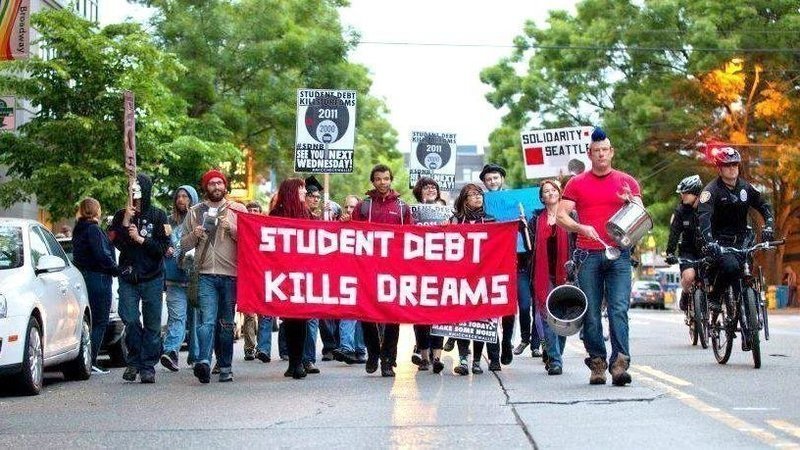
"#MicCheckWallStreet activists marching on Broadway on June 13 to protest student loan interest hikes."

Petition Closed
The Issue
The student loan crisis has left an entire generation financially crippled. After updates to personal bankruptcy laws in 2005 declared that student loans could no longer be discharged in bankruptcy, the massive amount of debt has impacted the economy in several ways: housing, retail, savings, consumer spending, etc. Politicians have been unable to agree on a solution, allowing the debt to compound and accumulate to over $1.5 TRILLION. Over 44 million Americans have student loans and recent studies estimate that 40% of student loans will be in default by 2023. (Brookings Institute, Urban Institute). Many of these Americans graduated during the recession and had to accept underemployment. A recent study released by The Federal Reserve Bank of St. Louis estimates that Millennials earn 34% less than what was projected and they may never financially recover from the recession. Many will never close the wage gap and will face depressed wages their entire careers. This is setting the stage for an economic disaster when this generation faces retirement.
While full forgiveness of student loans faces criticism and divides political parties, there are several solutions that can help alleviate the burden of this debt and prevent it from impacting future generations. We are asking Congress to consider the following:
1. Amend the bankruptcy laws to allow student loan debt to be discharged in bankruptcy.
2. Require schools and the government to enable students to select the amount of the loan that they want dispensed. Currently, at several schools it’s an all or nothing process. (For example, if you are eligible for $10,500 and you only need $2,000 then you have to elect to accept the $10,500. You must then wait until the money is disbursed to you and then set up your account to pay the loan back, but while you are in school, the loan program doesn’t collect on your loans so the process is unnecessarily complicated and confusing).
3. Outlaw retroactive billing after lost scholarships or assistantships. A large percentage of student loans are due to a school billing a student for the semester prior to losing a scholarship. For example, if you are attending a university on scholarship and your GPA falls below the requirements, it is expected that you lose your scholarship going forward. However, schools often bill you for the semester in which you lost the scholarship or assistantship. This forces a lot of students to drop out and universities refuse to release transcripts until they are paid so they are unable to transfer to complete their degree.
4. Update regulation regarding transcript release. Currently, universities are required to release your official transcript only once if you owe money. Several jobs and professional certifications require an official transcript. This prevents workers from pursuing professional development that would increase their pay. The transcripts are withheld even if the graduate degree or courses are being paid for by the employer.
Here’s a common case: a student graduates undergrad and decides to pursue a graduate degree at the same university. They receive a scholarship and successfully complete 3 semesters. In their 4th semester they fall victim to the “C rule” (in grad school, most programs kick you out after 2 or 3 “C” grades) in their program and fail the program, lose their scholarship and are billed for their final semester. Years later, their employer offers to pay for an MBA so they can get a promotion. The school refuses to release the undergrad transcripts because money is still owed on the graduate degree.
5. Set limits:
A. Interest rates: 7-8% on this type of loan is excessive. These loans can’t be discharged in bankruptcy. The risk of default is the primary driver in loan rates. The higher education system in the US is being built and sustained with student loans. There are several arguments for the government to cover tuition but at the very least the government should use the interbank loan rate or the risk-free rate on their student loans.
B. Lifetime interest: Total interest accumulated should not surpass the total principal of the loans. In other words, if you accepted $40,000 in student loans, the lifetime limit of interest accumulated on those loans should not exceed $40,000. Ideally, the lifetime interest cap would be set as low as possible.
C. Credit rationing: limits on total loan amount owed should be capped.
These changes do not forgive student loans, however they do address the crisis in a productive way that will prevent the current levels from escalating and will provide relief to millions of Americans overwhelmed by their student loan debt.
Please sign this petition to ask Congress to consider reforming student loan regulation.
Photo:
PHOTO BY ALEX GARLAND
"#MicCheckWallStreet activists marching on Broadway on June 13 to protest student loan interest hikes."


Petition Updates
Share this petition
Petition created on April 10, 2019