PETITION: Independent Investigation of the Shelburne Police Department (MA)
The Issue
PETITION: Independent Investigation of the Shelburne Police Department
Initiated by John F. Sendelbach · Shelburne Falls, Massachusetts · June 2026
To: Massachusetts Attorney General Andrea Campbell · Massachusetts POST Commission · Northwestern District Attorney's Office · Shelburne Board of Selectmen · Buckland Board of Selectmen · Franklin County Sheriff's Department
Key Facts at a Glance
- A Shelburne Police sergeant documented in his own official report that he would not contact one party in an ongoing dispute — regardless of evidence
- Eight police reports were filed against me between 2020 and 2023; I was never contacted or interviewed before any of them
- A written warning that someone would "get hurt" was received by the department fourteen months before the assault occurred; no action was taken
- The department has produced zero documents in response to a formal public records request filed ten months ago
- A federal judge denied qualified immunity to Detective Tucker Jenkins in March 2026 for conduct that follows the same pattern as his handling of my case
- On November 30, 2025, I was physically assaulted on a public sidewalk; more than thirty blows; my recording phone thrown into the Deerfield River; a cardiac emergency followed
- Two defendants were arraigned April 7, 2026; active criminal proceedings are pending
CLICK HERE FOR FULLY DOCUMENTED ABUSE TIMELINE
ALSO READ THE FOLLOWING:
DOSSIER: Chief Gregory Bardwell
DOSSIER: Detective Tucker Jenkins
DOSSIER: Sergeant Kurt Gilmore
DOSSIER: Officer Pettingill
DOSSIER: Henry "Brook" Batteau
DOSSIER: Alouette (Lou) Batteau
The Policy That Made This Predictable
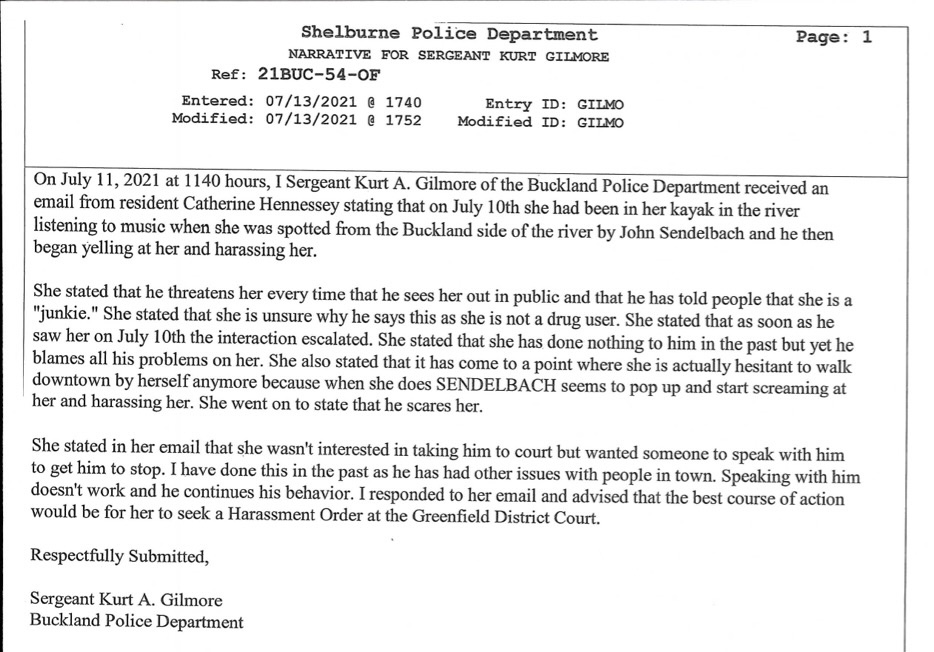
In July 2021, Sergeant Kurt Gilmore of the Shelburne Police Department wrote the following in an official incident report (21BUC-54-OF):
"I told Hennessey that I was not going to call Sendelbach because it hasn't worked in the past."
That sentence is departmental policy. It is written by a sergeant in an official record, never retracted, and followed for the next four years. It states explicitly that one party in an ongoing dispute would receive police response and engagement — and the other would not — regardless of what that other party reported, regardless of what evidence showed, regardless of what equal protection under the Fourteenth Amendment requires.
Between 2020 and 2023, Katherine Hennessey filed approximately eight police reports against me. I was never contacted before any of them. The first official contact this department initiated with me was when a process server handed me an emergency criminal charge — three years into the documented pattern. Every one of those reports collapsed the first time anyone examined evidence. The department generated zero corrective actions across all eight.
---
Five Steps From Policy to Assault
Step 1 — 2020: The policy is established.
On June 29, 2020, Sergeant Gilmore emails Hennessey: "I've talked to John. It doesn't work." The department designates one party as deserving protection. The other is designated as not worth calling.
Step 2 — 2020–2023: The policy produces eight unverified reports.
Each report filed without interviewing me. Each collapsed on first evidence review. A criminal harassment charge co-signed by Detective Jenkins and Officer Pettengill — neither of whom had ever met me — produced a No Probable Cause finding in June 2023 (Docket 2341AC000088) after a clerk magistrate spent one hour reviewing evidence I presented. Jenkins was present. He took no corrective action.
Step 3 — September 2024: A written warning is received and ignored.
Katherine Hennessey wrote to my commercial landlord: "It's really only a matter of time before someone gets hurt." That letter was forwarded to this department and received by Detective Jenkins. He read it approximately twelve days late. He filed no report. He issued no warning. He took no action of any kind.
Step 4 — October–November 2025: Warnings in person are also ignored.
On October 16, 2025, I stood in front of Chief Bardwell at a gas station in documented atrial fibrillation and asked him to feel my pulse. He declined and walked into the store for coffee. That exchange is on video. Three days later, a Massachusetts State Police officer called EMS because my heart rate was fluctuating between 130 and 230 beats per minute, recorded by a LIFEPAK 15 cardiac monitor. Officer Sheerer is a neutral third-party witness. On November 29, 2025, I sent a warning email to the entire department and both Select Boards naming the defendant and announcing imminent legal action. The department had it by 7 PM. No preventive action followed.
Step 5 — November 30, 2025: The assault.
At 5:32 PM, Brook Batteau charged out of Floodwater Brewing in Buckland and shoved me off the curb. Katherine Hennessey exited seconds later. A second individual pinned my arms from behind. Hennessey struck me more than a dozen times in the head and face. I did not retaliate. My recording phone was seized and thrown into the Deerfield River while still recording. A second battery followed. Zachary Livingston, co-owner of Floodwater Brewing, provided a sworn statement to Sergeant Gilmore on December 9, 2025. Brook Batteau told him directly: "You don't understand, John has been after my family for five years." That is premeditation, stated to a neutral witness, immediately after the assault.
Sergeant Gilmore's probable cause findings followed on December 11, 2025. Katherine Hennessey and Brook Batteau were arraigned on April 7, 2026.
---
What Happened After the Assault
I had no phone. Hennessey had thrown it in the river. When I tried to re-enter Floodwater Brewing to identify witnesses, I was physically blocked — grabbed from behind by multiple people and pulled back from the entrance. The assault victim was prevented from accessing the assault scene by people connected to the assailants.
Knowing from experience that Shelburne Police are rarely at the station, I drove directly to the Massachusetts State Police barracks on Route 2 — approximately two miles away. State Police were already in radio contact with Shelburne about the incident. They got on the radio and agreed that someone would meet me at the Shelburne station. I drove there.
The station was dark. Nobody was there. I knocked on the rear door where the cruisers park. Nothing. I walked around to the front lobby entrance and knocked. Nothing. I stood outside for approximately fifteen minutes — no phone, no way to call anyone, having just been beaten, not knowing whether more was coming.
One cruiser was in the parking area with the engine running. Because Shelburne cruisers have heavily tinted windows, I could not see whether anyone was inside. I had to physically position a streetlight behind the vehicle to backlight the glass enough to determine the car was empty. It was. Sergeant Gilmore had left his cruiser running and unattended while the assault victim he had agreed to meet waited outside a dark station.
Gilmore's own report shows he used the waiting period to call Zachary Livingston by phone. When he finally came out, he interviewed me and then drove to Hennessey's residence. He interviewed the assault defendants in their living room before their written statements were due. Those statements, submitted December 1, became the foundation of Hennessey's HPO petition filed the same morning — the petition Judge Mazanec denied with prejudice two weeks later after watching her own video evidence contradict every claim.
The next day, Gilmore called to inform me that papers had arrived — not my HPO, as he claimed to have expected, but Hennessey's December 1 HPO against me. He stated he was surprised when he pulled it from the fax because he thought it would be mine. That statement inadvertently confirmed what the report does not say directly: Gilmore had advised Hennessey and Batteau to seek HPOs against me during the living room interview, before he had completed his investigation, before I had filed anything. He knew an HPO filing was coming. He was surprised only about which direction it came from. He had coached the defendants the night of the assault, and his own surprise phone call the next morning documented that coaching.
The Aggressor This Department Chose Not to Document
Before Brook Batteau charged out of Floodwater, a man I had never met in my life exited the brewery screaming profanities at me — positioning himself approximately one foot from my face, calling me a "fucking asshole," a "fucking moron," an "idiot." He initiated the confrontation. He primed the scene for everything that followed.
I identified this man to Sergeant Gilmore on scene that night. I pointed him out through the brewery window. His first name was Tom, he wore glasses, had a beard, and was a known musical collaborator of Alouette Batteau. Gilmore's response when I pointed: "Don't point at him."
Tom Del Negro does not appear in Gilmore's official report by name. He appears as "a male" in a single clause. He was never interviewed. He was never identified. The man who initiated the assault — who charged out of a building screaming at a stranger he had never met, positioning himself one foot from that stranger's face before Batteau came out behind him — was identified by the victim on scene, discouraged from being identified by the responding officer, and then omitted from the official record.
This is the difference between failing to find a witness and declining to document one after the victim pointed to him through a window.
The Evidence This Department Never Preserved
Three camera sources covering the November 30 assault location were never checked by responding officers:
- Neighbors Gas Station — would have documented the morning trespass and refuted Hennessey's December 1 sworn affidavit. Never requested. Presumed gone.
- Law office across State Street — exterior camera covering the exact trespass location. Never contacted
- Crystal Visions, 40 State Street — direct sightline to the river throw point. Never contacted.
Floodwater Brewing interior footage was requested nine days after the assault. The system had already overwritten the data. The three-camera failure was not bad luck. It was the predictable result of a department that had never been required to canvass available cameras within a defined radius and document that canvass.
---
The Records This Department Won't Produce
On August 25, 2025, I filed a formal public records request (SPR25/2545) seeking the department's internal records on complaint processing, officer communications, and policies relevant to the documented pattern. These are public records. Massachusetts law entitles citizens to them.
As of today, ten months later, not a single document has been produced.
The Supervisor of Records granted a 30-business-day extension in September 2025. That deadline passed in October 2025. Zero documents have followed. A department with nothing to hide does not spend ten months preventing a citizen from seeing its own records.
---
The Federal Court Has Confirmed the Pattern
On March 12, 2026, United States District Judge Mark G. Mastroianni denied qualified immunity to Detective Tucker Jenkins personally in Mlynick v. Town of Erving et al. (Case No. 3:24-cv-30108, USDC District of Massachusetts). The court found it plausible that Jenkins provided misleading information and ignored exculpatory facts to manufacture probable cause against a different citizen in a separate case — using the same investigative mechanism he used in my case: arriving with a pre-formed conclusion, building a charge from one side's unverified complaints, filing without interviewing the accused.
That federal finding does not involve me. It involves a different citizen, a different dispute. The same detective. The same mechanism. The same department. Federal discovery in that case continues through January 2027.
Thirteen days after that ruling, Chief Bardwell submitted a merit raise request for his department. The Select Board approved it. Select Board Chair Rick LaPierre described it as "well worth it."
---
The Department's Personnel Record
Chief Bardwell asked the Select Board to evaluate his department's merit in isolation. The full record:
- Former Chief James T. Hicks — resigned following sexual misconduct allegations
- Former Officer Jacob Wrisley — convicted of possession and distribution of child sexual abuse material, some accessed on department devices while on duty; sentenced to four to five years; permanently decertified by the Massachusetts POST Commission, Case No. 2025-020
- Part-time officer Paul John Herbert — collected $344,000 in fraudulent VA disability benefits by fabricating combat service for thirteen years; pleaded guilty March 2025; identified by federal investigators, not local ones
- Sergeant Kurt Gilmore — author of the written non-contact policy; advised assault defendants to seek civil protection orders against the assault victim the night of the assault, before completing the criminal investigation
- Detective Tucker Jenkins — co-signed a criminal charge against a man he had never met; subject of a 2025 DA investigation for boundary violations with a student (school terminated him; Select Board retained him over a 218-signature removal petition); personally denied qualified immunity in federal court, March 2026
- Chief Gregory Bardwell — declined on video to take the pulse of a citizen in documented atrial fibrillation; stated on video that he cannot charge false police reports (factually incorrect under M.G.L. c. 269 §13A); classified a violent lyric directed at a complaining witness in active criminal proceedings as "part of a musical performance" in a written response copied to the DA's office
On March 25, 2026 — thirteen days after the federal qualified immunity denial — Chief Bardwell submitted a merit raise request for the department. The Select Board approved it.
---
What This Has Cost
I am a metalworker and public artist with thirty years of permanent public installations in this community. I have lived in Shelburne Falls for eighteen years.
I was diagnosed with atrial fibrillation in 2021, attributed by my physician to the chronic stress of a six-year campaign this department's written policy enabled. The American Heart Association documents that untreated atrial fibrillation reduces life expectancy by five to ten years. Each documented episode in this record is traceable to a specific event: the June 2020 viral video campaign; the September 2024 Walker letter period; the October 2025 gas station encounter; the November 2025 assault; the March 2026 HPO hearing. Each dated. Each traceable.
The body kept the score the department refused to keep.
---
Why Independent Review Is Needed Now
A pre-trial conference in the active criminal cases is scheduled for June 30, 2026. Once those proceedings develop further, the opportunity for independent review of the institutional conditions that produced them narrows. An investigation that runs parallel to or after a criminal trial is a different instrument than one that can examine the full pattern before it is further shaped by adversarial proceedings.
There is also a broader public safety question that extends beyond this case. If a department can apply a documented written policy of selective enforcement to a long-term community member with a six-year paper trail, it can apply the same policy to any resident with fewer resources to document it. The July 2021 Gilmore report is a public document. It describes a practice. That practice did not begin with me and there is no reason to conclude it ended with me. The petition section below invites others who have experienced this department's complaint processing to come forward. The pattern the department has never been required to correct cannot be corrected unless it is fully visible.
---
What We Are Demanding
1. An independent investigation by the Massachusetts Attorney General into: the written non-contact policy and its compliance with equal protection requirements; the department's handling of eight reports filed without interviewing the accused; the failure to act on the September 2024 written warning; the November 30 investigative failures; the public records obstruction; and the May 2026 surveillance pattern following publication of a whistleblower safety statement. A public report with binding recommendations — not an internal review — is the appropriate outcome.
2. A POST Commission review of whether this department currently meets Massachusetts certification standards, given the documented pattern of misconduct across multiple personnel, the active federal civil rights litigation with qualified immunity denied, and the department's current reliance on outside legal compliance remediation.
3. A public accounting from the Select Board — on the public record, not in executive session — of what review was conducted before approving merit raises thirteen days after a federal qualified immunity denial; what review was conducted before retaining Detective Jenkins over a 218-signature removal petition; and what the board's policy is for responding to formal constituent complaints about documented officer misconduct. Ninety-nine percent of communications to this Select Board on these issues went unanswered. That silence is itself an answer that belongs in the public record.
4. Mandatory camera canvass protocols requiring responding officers to document all available camera sources within a defined radius within 24 hours of any incident in a documented ongoing matter. The three-camera failure on November 30 was not bad luck. It was the predictable result of a department that had never been required to do the work.
5. A prohibition on HPO coaching by responding officers — no advising parties in an active criminal investigation to seek civil protection orders before the criminal investigation is complete.
---
Other Documented Cases — The Pattern Is Not Singular
A Monell civil rights claim — the legal theory that holds a municipality liable for a pattern or practice of constitutional violations — requires evidence that the conduct was not isolated. The federal court record in Mlynick v. Town of Erving et al. documents a second case involving the same detective and the same mechanism. A third individual with direct knowledge of this department has experienced a nearly identical sequence involving the same officers.
If you have had your own experience with the Shelburne Police Department involving one-sided complaint processing, failure to investigate your reports while acting on complaints made against you, or conduct you believe reflected institutional bias, your account is relevant to the documented pattern and may be material to the pending civil rights proceedings. Please share your experience in the comments or contact me: flyingisland1@yahoo.com.
Every fact in this petition is drawn from police reports, court dockets, federal court orders, DA investigations, sworn testimony, medical records, and documented video and audio evidence. All cited case numbers, report numbers, and docket numbers are on the public record. Nothing in this petition is a legal conclusion. All referenced legal findings are those of sitting judges in active proceedings.
READ MY WHISTLEBLOWER SAFETY STATEMENT HERE.
To contact the Massachusetts Attorney General: http://www.mass.gov/ago
To contact the POST Commission: http://www.mass.gov/post
Full documented archive: http://johnsendelbach.com — no login, no fee
---
Active criminal cases: Commonwealth v. Hennessey (2641CR000158) and Commonwealth v. Batteau (2641CR000159), Franklin County District Court
Federal civil rights case: Mlynick v. Town of Erving et al., 3:24-cv-30108, USDC District of Massachusetts — qualified immunity denied March 12, 2026
The phone is in the Deerfield River. The record is not.
John F. Sendelbach · Shelburne Falls, Massachusetts · June 2026
8
The Issue
PETITION: Independent Investigation of the Shelburne Police Department
Initiated by John F. Sendelbach · Shelburne Falls, Massachusetts · June 2026
To: Massachusetts Attorney General Andrea Campbell · Massachusetts POST Commission · Northwestern District Attorney's Office · Shelburne Board of Selectmen · Buckland Board of Selectmen · Franklin County Sheriff's Department
Key Facts at a Glance
- A Shelburne Police sergeant documented in his own official report that he would not contact one party in an ongoing dispute — regardless of evidence
- Eight police reports were filed against me between 2020 and 2023; I was never contacted or interviewed before any of them
- A written warning that someone would "get hurt" was received by the department fourteen months before the assault occurred; no action was taken
- The department has produced zero documents in response to a formal public records request filed ten months ago
- A federal judge denied qualified immunity to Detective Tucker Jenkins in March 2026 for conduct that follows the same pattern as his handling of my case
- On November 30, 2025, I was physically assaulted on a public sidewalk; more than thirty blows; my recording phone thrown into the Deerfield River; a cardiac emergency followed
- Two defendants were arraigned April 7, 2026; active criminal proceedings are pending
CLICK HERE FOR FULLY DOCUMENTED ABUSE TIMELINE
ALSO READ THE FOLLOWING:
DOSSIER: Chief Gregory Bardwell
DOSSIER: Detective Tucker Jenkins
DOSSIER: Sergeant Kurt Gilmore
DOSSIER: Officer Pettingill
DOSSIER: Henry "Brook" Batteau
DOSSIER: Alouette (Lou) Batteau
The Policy That Made This Predictable
In July 2021, Sergeant Kurt Gilmore of the Shelburne Police Department wrote the following in an official incident report (21BUC-54-OF):
"I told Hennessey that I was not going to call Sendelbach because it hasn't worked in the past."
That sentence is departmental policy. It is written by a sergeant in an official record, never retracted, and followed for the next four years. It states explicitly that one party in an ongoing dispute would receive police response and engagement — and the other would not — regardless of what that other party reported, regardless of what evidence showed, regardless of what equal protection under the Fourteenth Amendment requires.
Between 2020 and 2023, Katherine Hennessey filed approximately eight police reports against me. I was never contacted before any of them. The first official contact this department initiated with me was when a process server handed me an emergency criminal charge — three years into the documented pattern. Every one of those reports collapsed the first time anyone examined evidence. The department generated zero corrective actions across all eight.
---
Five Steps From Policy to Assault
Step 1 — 2020: The policy is established.
On June 29, 2020, Sergeant Gilmore emails Hennessey: "I've talked to John. It doesn't work." The department designates one party as deserving protection. The other is designated as not worth calling.
Step 2 — 2020–2023: The policy produces eight unverified reports.
Each report filed without interviewing me. Each collapsed on first evidence review. A criminal harassment charge co-signed by Detective Jenkins and Officer Pettengill — neither of whom had ever met me — produced a No Probable Cause finding in June 2023 (Docket 2341AC000088) after a clerk magistrate spent one hour reviewing evidence I presented. Jenkins was present. He took no corrective action.
Step 3 — September 2024: A written warning is received and ignored.
Katherine Hennessey wrote to my commercial landlord: "It's really only a matter of time before someone gets hurt." That letter was forwarded to this department and received by Detective Jenkins. He read it approximately twelve days late. He filed no report. He issued no warning. He took no action of any kind.
Step 4 — October–November 2025: Warnings in person are also ignored.
On October 16, 2025, I stood in front of Chief Bardwell at a gas station in documented atrial fibrillation and asked him to feel my pulse. He declined and walked into the store for coffee. That exchange is on video. Three days later, a Massachusetts State Police officer called EMS because my heart rate was fluctuating between 130 and 230 beats per minute, recorded by a LIFEPAK 15 cardiac monitor. Officer Sheerer is a neutral third-party witness. On November 29, 2025, I sent a warning email to the entire department and both Select Boards naming the defendant and announcing imminent legal action. The department had it by 7 PM. No preventive action followed.
Step 5 — November 30, 2025: The assault.
At 5:32 PM, Brook Batteau charged out of Floodwater Brewing in Buckland and shoved me off the curb. Katherine Hennessey exited seconds later. A second individual pinned my arms from behind. Hennessey struck me more than a dozen times in the head and face. I did not retaliate. My recording phone was seized and thrown into the Deerfield River while still recording. A second battery followed. Zachary Livingston, co-owner of Floodwater Brewing, provided a sworn statement to Sergeant Gilmore on December 9, 2025. Brook Batteau told him directly: "You don't understand, John has been after my family for five years." That is premeditation, stated to a neutral witness, immediately after the assault.
Sergeant Gilmore's probable cause findings followed on December 11, 2025. Katherine Hennessey and Brook Batteau were arraigned on April 7, 2026.
---
What Happened After the Assault
I had no phone. Hennessey had thrown it in the river. When I tried to re-enter Floodwater Brewing to identify witnesses, I was physically blocked — grabbed from behind by multiple people and pulled back from the entrance. The assault victim was prevented from accessing the assault scene by people connected to the assailants.
Knowing from experience that Shelburne Police are rarely at the station, I drove directly to the Massachusetts State Police barracks on Route 2 — approximately two miles away. State Police were already in radio contact with Shelburne about the incident. They got on the radio and agreed that someone would meet me at the Shelburne station. I drove there.
The station was dark. Nobody was there. I knocked on the rear door where the cruisers park. Nothing. I walked around to the front lobby entrance and knocked. Nothing. I stood outside for approximately fifteen minutes — no phone, no way to call anyone, having just been beaten, not knowing whether more was coming.
One cruiser was in the parking area with the engine running. Because Shelburne cruisers have heavily tinted windows, I could not see whether anyone was inside. I had to physically position a streetlight behind the vehicle to backlight the glass enough to determine the car was empty. It was. Sergeant Gilmore had left his cruiser running and unattended while the assault victim he had agreed to meet waited outside a dark station.
Gilmore's own report shows he used the waiting period to call Zachary Livingston by phone. When he finally came out, he interviewed me and then drove to Hennessey's residence. He interviewed the assault defendants in their living room before their written statements were due. Those statements, submitted December 1, became the foundation of Hennessey's HPO petition filed the same morning — the petition Judge Mazanec denied with prejudice two weeks later after watching her own video evidence contradict every claim.
The next day, Gilmore called to inform me that papers had arrived — not my HPO, as he claimed to have expected, but Hennessey's December 1 HPO against me. He stated he was surprised when he pulled it from the fax because he thought it would be mine. That statement inadvertently confirmed what the report does not say directly: Gilmore had advised Hennessey and Batteau to seek HPOs against me during the living room interview, before he had completed his investigation, before I had filed anything. He knew an HPO filing was coming. He was surprised only about which direction it came from. He had coached the defendants the night of the assault, and his own surprise phone call the next morning documented that coaching.
The Aggressor This Department Chose Not to Document
Before Brook Batteau charged out of Floodwater, a man I had never met in my life exited the brewery screaming profanities at me — positioning himself approximately one foot from my face, calling me a "fucking asshole," a "fucking moron," an "idiot." He initiated the confrontation. He primed the scene for everything that followed.
I identified this man to Sergeant Gilmore on scene that night. I pointed him out through the brewery window. His first name was Tom, he wore glasses, had a beard, and was a known musical collaborator of Alouette Batteau. Gilmore's response when I pointed: "Don't point at him."
Tom Del Negro does not appear in Gilmore's official report by name. He appears as "a male" in a single clause. He was never interviewed. He was never identified. The man who initiated the assault — who charged out of a building screaming at a stranger he had never met, positioning himself one foot from that stranger's face before Batteau came out behind him — was identified by the victim on scene, discouraged from being identified by the responding officer, and then omitted from the official record.
This is the difference between failing to find a witness and declining to document one after the victim pointed to him through a window.
The Evidence This Department Never Preserved
Three camera sources covering the November 30 assault location were never checked by responding officers:
- Neighbors Gas Station — would have documented the morning trespass and refuted Hennessey's December 1 sworn affidavit. Never requested. Presumed gone.
- Law office across State Street — exterior camera covering the exact trespass location. Never contacted
- Crystal Visions, 40 State Street — direct sightline to the river throw point. Never contacted.
Floodwater Brewing interior footage was requested nine days after the assault. The system had already overwritten the data. The three-camera failure was not bad luck. It was the predictable result of a department that had never been required to canvass available cameras within a defined radius and document that canvass.
---
The Records This Department Won't Produce
On August 25, 2025, I filed a formal public records request (SPR25/2545) seeking the department's internal records on complaint processing, officer communications, and policies relevant to the documented pattern. These are public records. Massachusetts law entitles citizens to them.
As of today, ten months later, not a single document has been produced.
The Supervisor of Records granted a 30-business-day extension in September 2025. That deadline passed in October 2025. Zero documents have followed. A department with nothing to hide does not spend ten months preventing a citizen from seeing its own records.
---
The Federal Court Has Confirmed the Pattern
On March 12, 2026, United States District Judge Mark G. Mastroianni denied qualified immunity to Detective Tucker Jenkins personally in Mlynick v. Town of Erving et al. (Case No. 3:24-cv-30108, USDC District of Massachusetts). The court found it plausible that Jenkins provided misleading information and ignored exculpatory facts to manufacture probable cause against a different citizen in a separate case — using the same investigative mechanism he used in my case: arriving with a pre-formed conclusion, building a charge from one side's unverified complaints, filing without interviewing the accused.
That federal finding does not involve me. It involves a different citizen, a different dispute. The same detective. The same mechanism. The same department. Federal discovery in that case continues through January 2027.
Thirteen days after that ruling, Chief Bardwell submitted a merit raise request for his department. The Select Board approved it. Select Board Chair Rick LaPierre described it as "well worth it."
---
The Department's Personnel Record
Chief Bardwell asked the Select Board to evaluate his department's merit in isolation. The full record:
- Former Chief James T. Hicks — resigned following sexual misconduct allegations
- Former Officer Jacob Wrisley — convicted of possession and distribution of child sexual abuse material, some accessed on department devices while on duty; sentenced to four to five years; permanently decertified by the Massachusetts POST Commission, Case No. 2025-020
- Part-time officer Paul John Herbert — collected $344,000 in fraudulent VA disability benefits by fabricating combat service for thirteen years; pleaded guilty March 2025; identified by federal investigators, not local ones
- Sergeant Kurt Gilmore — author of the written non-contact policy; advised assault defendants to seek civil protection orders against the assault victim the night of the assault, before completing the criminal investigation
- Detective Tucker Jenkins — co-signed a criminal charge against a man he had never met; subject of a 2025 DA investigation for boundary violations with a student (school terminated him; Select Board retained him over a 218-signature removal petition); personally denied qualified immunity in federal court, March 2026
- Chief Gregory Bardwell — declined on video to take the pulse of a citizen in documented atrial fibrillation; stated on video that he cannot charge false police reports (factually incorrect under M.G.L. c. 269 §13A); classified a violent lyric directed at a complaining witness in active criminal proceedings as "part of a musical performance" in a written response copied to the DA's office
On March 25, 2026 — thirteen days after the federal qualified immunity denial — Chief Bardwell submitted a merit raise request for the department. The Select Board approved it.
---
What This Has Cost
I am a metalworker and public artist with thirty years of permanent public installations in this community. I have lived in Shelburne Falls for eighteen years.
I was diagnosed with atrial fibrillation in 2021, attributed by my physician to the chronic stress of a six-year campaign this department's written policy enabled. The American Heart Association documents that untreated atrial fibrillation reduces life expectancy by five to ten years. Each documented episode in this record is traceable to a specific event: the June 2020 viral video campaign; the September 2024 Walker letter period; the October 2025 gas station encounter; the November 2025 assault; the March 2026 HPO hearing. Each dated. Each traceable.
The body kept the score the department refused to keep.
---
Why Independent Review Is Needed Now
A pre-trial conference in the active criminal cases is scheduled for June 30, 2026. Once those proceedings develop further, the opportunity for independent review of the institutional conditions that produced them narrows. An investigation that runs parallel to or after a criminal trial is a different instrument than one that can examine the full pattern before it is further shaped by adversarial proceedings.
There is also a broader public safety question that extends beyond this case. If a department can apply a documented written policy of selective enforcement to a long-term community member with a six-year paper trail, it can apply the same policy to any resident with fewer resources to document it. The July 2021 Gilmore report is a public document. It describes a practice. That practice did not begin with me and there is no reason to conclude it ended with me. The petition section below invites others who have experienced this department's complaint processing to come forward. The pattern the department has never been required to correct cannot be corrected unless it is fully visible.
---
What We Are Demanding
1. An independent investigation by the Massachusetts Attorney General into: the written non-contact policy and its compliance with equal protection requirements; the department's handling of eight reports filed without interviewing the accused; the failure to act on the September 2024 written warning; the November 30 investigative failures; the public records obstruction; and the May 2026 surveillance pattern following publication of a whistleblower safety statement. A public report with binding recommendations — not an internal review — is the appropriate outcome.
2. A POST Commission review of whether this department currently meets Massachusetts certification standards, given the documented pattern of misconduct across multiple personnel, the active federal civil rights litigation with qualified immunity denied, and the department's current reliance on outside legal compliance remediation.
3. A public accounting from the Select Board — on the public record, not in executive session — of what review was conducted before approving merit raises thirteen days after a federal qualified immunity denial; what review was conducted before retaining Detective Jenkins over a 218-signature removal petition; and what the board's policy is for responding to formal constituent complaints about documented officer misconduct. Ninety-nine percent of communications to this Select Board on these issues went unanswered. That silence is itself an answer that belongs in the public record.
4. Mandatory camera canvass protocols requiring responding officers to document all available camera sources within a defined radius within 24 hours of any incident in a documented ongoing matter. The three-camera failure on November 30 was not bad luck. It was the predictable result of a department that had never been required to do the work.
5. A prohibition on HPO coaching by responding officers — no advising parties in an active criminal investigation to seek civil protection orders before the criminal investigation is complete.
---
Other Documented Cases — The Pattern Is Not Singular
A Monell civil rights claim — the legal theory that holds a municipality liable for a pattern or practice of constitutional violations — requires evidence that the conduct was not isolated. The federal court record in Mlynick v. Town of Erving et al. documents a second case involving the same detective and the same mechanism. A third individual with direct knowledge of this department has experienced a nearly identical sequence involving the same officers.
If you have had your own experience with the Shelburne Police Department involving one-sided complaint processing, failure to investigate your reports while acting on complaints made against you, or conduct you believe reflected institutional bias, your account is relevant to the documented pattern and may be material to the pending civil rights proceedings. Please share your experience in the comments or contact me: flyingisland1@yahoo.com.
Every fact in this petition is drawn from police reports, court dockets, federal court orders, DA investigations, sworn testimony, medical records, and documented video and audio evidence. All cited case numbers, report numbers, and docket numbers are on the public record. Nothing in this petition is a legal conclusion. All referenced legal findings are those of sitting judges in active proceedings.
READ MY WHISTLEBLOWER SAFETY STATEMENT HERE.
To contact the Massachusetts Attorney General: http://www.mass.gov/ago
To contact the POST Commission: http://www.mass.gov/post
Full documented archive: http://johnsendelbach.com — no login, no fee
---
Active criminal cases: Commonwealth v. Hennessey (2641CR000158) and Commonwealth v. Batteau (2641CR000159), Franklin County District Court
Federal civil rights case: Mlynick v. Town of Erving et al., 3:24-cv-30108, USDC District of Massachusetts — qualified immunity denied March 12, 2026
The phone is in the Deerfield River. The record is not.
John F. Sendelbach · Shelburne Falls, Massachusetts · June 2026
Petition Updates
Share this petition
Petition created on June 24, 2026